
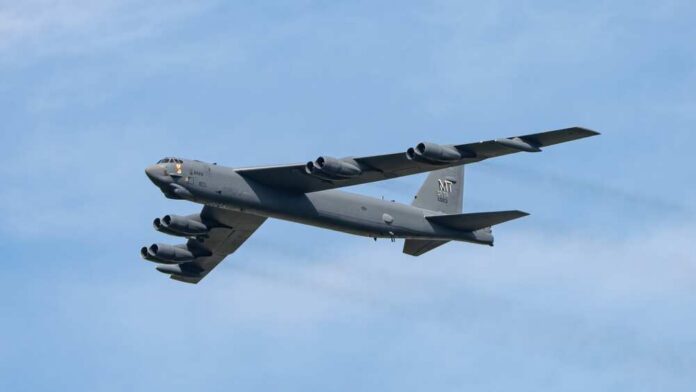
President Trump said Air Force pilots told him a round object blew past an F-22 at triple its speed — and it has Washington buzzing.
Story Snapshot
- Trump relayed pilots’ accounts from Oval Office meetings about “very strange” aerial encounters.
- He quoted them saying a round, non-aerodynamic object outran an F-22 by three times.
- CBS aired the remarks; other outlets echoed the same details and wording.
- No pilots were named in the interview, and no incident file was cited.
What Trump Said On National Television
President Trump told 60 Minutes he met “great, great” Air Force pilots in the Oval Office who described “very strange” things in the air. He quoted them saying, “Something goes by them at three times their speed, and it’s round. It’s not aerodynamic, it’s round.” The exchange aired and appears in the published transcript, which preserves that wording. He also described the pilots as serious professionals, not conspiracy chasers.
Coverage after the broadcast repeated the same core claim: a round object, not shaped like a normal aircraft, shot past an F-22 at three times its speed. Syndicated reports and follow-on segments matched the details Trump gave on television, including the emphasis on the object’s shape and the speed comparison. This consistency across outlets suggestsoutlets suggests the quotation was clear and specific in the original interview, not a later paraphrase.
What We Know And What Was Not Specified
The interview placed the pilot meetings during Trump’s first term and part of his second. It did not include the pilots’ names, the flight date, the squadron, or the airspace. Trump did not cite an incident number, sensor data, or a formal investigative record in that segment. That leaves the public with his on-record account of what pilots told him, without the mission details aviation analysts would use to reconstruct an event.
One brief caveat belongs here and only here: the pilots themselves were not identified on-air. That means the public material consists of Trump’s description of their story, not their own direct statements in that broadcast or transcript.
How This Fits The UAP Pattern In Military Airspace
Reports of unusual objects often cluster where the military flies. Pilots there see more traffic, drones, test systems, and odd atmospheric effects. The Department of Defense’s All-domain Anomaly Resolution Office reviewed decades of cases and found that most investigated sightings turned out to be ordinary objects or effects once it gathered and compared good data. Still, the office left room for new or experimental technologies within some reports.
Trump told 60 Minutes that Air Force pilots saw something round pass their F-22 at 3x its speed. He also said "maybe it was a comet," and in October said 4x. No pilots, dates or places named. A secondhand story, not evidence.
Should the full reports be released? #UFO #UAP pic.twitter.com/aNqBqwzhWx
— ExplainedinSixty (@Explainedin60) November 10, 2026
NASA’s independent study team said the same thing in plainer terms. The team found that poor sensor calibration, missing metadata, and single-source captures make many events hard to nail down. When data improved, several striking cases turned out to be sensor artifacts or misreads. The study pushed for better, open data that can lock down range, speed, and path so that testimony can be matched to measurable facts instead of memory or impression.
Why The Specifics Matter For National Security
A claim that something paced an F-22 at triple its speed raises real national security stakes. The F-22 is a top-tier fighter meant to police contested skies. If an object can outrun it, leaders need to know whether it was a misread, a drone-swarm trick, a classified test, or a foreign platform. American conservative values prize strong defense and clear accountability. That starts with identifying the pilots, matching the mission logs, and securing the radar and infrared tracks if they exist. That is basic due diligence.
Trump’s on-record comments created a task list that does not require drama. The next steps are straightforward: identify the aviators he met, pull the flight date, unit, and airspace, and check radar and cockpit systems for range and closure data. If the event occurred, the best evidence will live in those tracks and debriefs. If it was a misidentification, the same records will sort it out. Either way, facts first, then conclusions — the only way to keep our pilots safe and our airspace under control.
Sources:
foxnews.com, whmi.com, archive.org, metro.co.uk, war.gov