
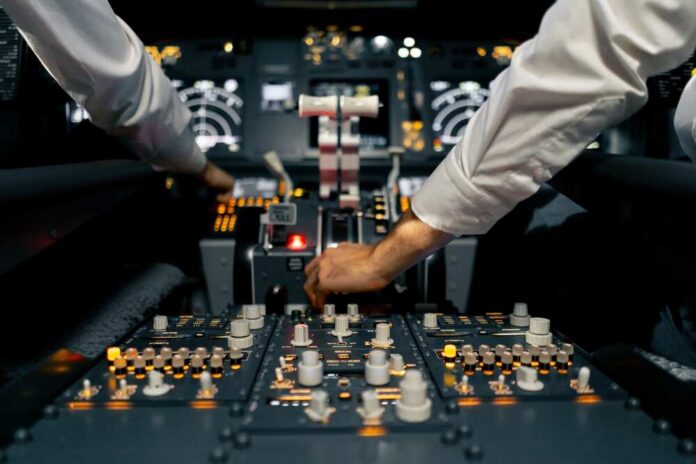
The cockpit went into lockdown midair after a flight attendant reported seeing a passenger text about hijacking.
Story Snapshot
- United Flight 1681 returned safely to Las Vegas after a reported passenger disturbance.
- The pilot radioed that a flight attendant saw a text about hijacking, then the crew went into lockdown.
- The Federal Aviation Administration (FAA) opened an investigation into the incident.
- Passengers deplaned for security checks; no injuries were reported.
Lockdown At Altitude, Turnback To Las Vegas
United Airlines Flight 1681 departed Las Vegas for Newark on October 24 when the crew reported a passenger disturbance. The aircraft returned and landed safely at Harry Reid International Airport around 11:05 p.m. local time, according to the Federal Aviation Administration. Air traffic control audio captured the pilot stating that a flight attendant saw a passenger texting about hijacking. The pilot said the crew initiated a cockpit lockdown and turned back to Las Vegas.
Reports identified the flight as carrying about 150 passengers and six crew, operating the Las Vegas to Newark route on Saturday night. The airline described the situation as a potential security concern and coordinated with authorities upon landing. The decision to return rather than continue to Newark matched standard playbooks after a possible in-cabin threat. Crews train to err on the side of safety, secure the flight deck, and divert to the nearest suitable airport.
What Triggered The Response Onboard
The cockpit recording relayed a simple sequence: a flight attendant observed a troubling text, alerted the captain, the cockpit locked down, and the flight turned back. The Federal Aviation Administration called it a passenger disturbance and said the agency would investigate. That phrasing signals a common aviation security fact pattern. Crews do not wait for perfect clarity. They act fast, control access to the cockpit, and remove uncertainty by landing where police and screeners can check every variable.
Post-landing procedures followed a familiar script. Passengers deplaned in Las Vegas. Security personnel inspected people and the aircraft. Officials reported no injuries linked to the incident. The focus shifted to confirming whether the observed message reflected a real threat, a poor choice of words, or something unrelated. The investigative step protects due process for the passenger while also stress-testing the crew’s in-flight judgment under pressure.
Why Aviation Treats Ambiguity Like Urgency
Since September 11, airline security has trained pilots and attendants to treat any possible hijack signal as actionable. False alarms do happen, yet the logic is sound: the cost of missing the one true warning is far greater than the cost of a diversion. Past scares show this risk math in action. A 2019 event at Amsterdam Schiphol began with a mistaken hijack code and still triggered a major response, because that is how you keep airplanes safe.
Research on unruly or threatening behavior underscores the “see something, say something” mindset. Frontline crews scan for cues, escalate quickly, and hand off to law enforcement on the ground to verify details. That process protects the flight deck and passengers while keeping final judgments with investigators. The Las Vegas return fits that framework: a clear alert, an immediate lockdown, a diversion, and then orderly checks by airport and federal teams.
The Facts That Matter Most Right Now
The Federal Aviation Administration has confirmed the safe return and an active review. The pilot’s radio report, captured on control audio, described the hijack text sighting and the decision to lock down. The airline treated the situation as a security concern. Passengers left the aircraft for screening, with no reported injuries. These concrete steps reflect a conservative, common-sense safety culture: secure the plane first, then answer every question. One brief caveat remains: officials have not publicly detailed the text’s exact wording or final findings.
Sources:
people.com, newsnationnow.com, 8newsnow.com, uk.news.yahoo.com, yahoo.com