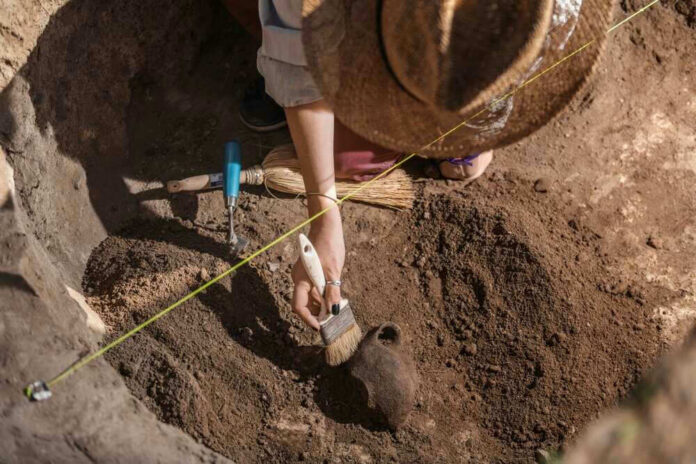
Archaeologists hauled nearly a thousand soil samples and fresh pottery shards from the slopes near Mount Ararat, moving the hunt for Noah’s Ark from legend to lab work.
Story Snapshot
- Teams expanded digs at the Durupınar formation near Mount Ararat.
- Researchers reported almost 1,000 soil samples sent for analysis.
- Pottery fragments found near the boat-shaped outline span ancient eras.
- Turkish and partner institutions coordinated permits and fieldwork.
Fieldwork Intensifies At Durupınar With Heavy Sampling
Researchers escalated excavation and sampling at the Durupınar site in eastern Turkey. The effort centers on a boat-shaped ridge long tied to the Noah’s Ark account.
The current team reported pulling nearly a thousand soil samples for laboratory testing in Ankara, a sharp jump from earlier campaigns that used only a few dozen samples. Large-scale sampling matters because it can confirm or reject chemical patterns with stronger confidence than small, scattered tests.
Project leaders coordinated permits through Turkish authorities and universities, signaling a more formal approach than past, smaller ventures. Sivas Cumhuriyet University archaeologist Cenker Atila is listed as directing the expedition, with official approvals documented by the project’s public materials.
That structure helps standardize how cores are taken, tracked, and analyzed. Better controls and chain of custody are the difference between a headline and a dataset that stands up to peer scrutiny.
Pottery Shards Anchor Human Activity In The Area
Teams reported pottery fragments outside the formation dating from the Copper Age through the Iron Age, placing people in the area thousands of years ago. Pottery proves people were there, not what they built.
If a ridge hides an ancient structure, nearby human debris often tells its age range and use. If the ridge is natural, the same pottery still helps map settlement and travel routes on the Ararat frontier. Either way, the shards add a solid timeline.
Earlier phases found smaller sets of rock and soil with traces of clay-like materials and marine deposits, dated to roughly 3,500 to 5,000 years before present by Istanbul Technical University, according to reports the team presented.
Those findings, if reproduced in the expanded sampling, would suggest a complex geological story at high elevation. Whether that story includes a preserved hull is exactly what the new cores and lab runs aim to test next.
Noah’s Ark Mystery Deepens as New Discoveries Emerge Near Mount Ararathttps://t.co/yG9OGhBGyS
— Arkeonews (@ArkeoNews) September 23, 2026
What The Lab Will Likely Look For Next
Analysts will compare the chemistry inside the boat-shaped outline to soil just outside it. Prior reports and summaries describe higher organic matter, different acidity, and elevated potassium inside the outline, which some link to decayed wood and ash patterns.
The new thousand-sample push can test those claims with tighter grids, better controls, and blind lab protocols. If the inside-outside contrast repeats cleanly and stops at the outline, that pattern gets harder to dismiss.
Direct, stratified evidence would carry the most weight: worked timber fibers, tool-marked fasteners, or layered cultural deposits that match a build, a use, and a burial.
Short of that, a strong geochemical boundary tied to a defined shape still compels more coring and targeted trenches. Good science earns trust by ruling out simpler causes first: natural erosion lines, soil creep, and landslide deposits that only mimic a man-made shape.
Why This Push Feels Different
Durupınar has cycled through hype and letdown for decades. The current effort looks different because it scales up sampling, broadens institutional backing, and publishes technical claims that outside labs can check.
Jerusalem Post coverage tracks the step-by-step pathway: collect, log, ship, and analyze in named laboratories, then present dated results tied to specific materials. That cadence fits how real digs move from field buzz to durable findings, or to clear, data-backed nulls.
🔥🔥 Noah's Ark 🔥🔥
After 70 years, Researchers with @noahsarkscans have secured permits and begun core drilling at the Durupinar site near Mount Ararat in eastern Turkey.
Genesis 8:4: "And the ark rested in the seventh month, on the seventeenth day of the month, upon the… pic.twitter.com/tagKOCgrbi
— KJofTikTok (@TheKJofTikTok) September 23, 2026
One caveat remains standard in archaeology: pottery and soil chemistry show context, not identity. Officials and researchers quoted across reports stress that pottery signals ancient activity, while the formation’s nature still rests on what deeper cores and trenches reveal.
Sources:
arcimaging.org, buttondown.com, metro.co.uk, dailymail.com, jpost.com, noahsarkscans.com, x.com