
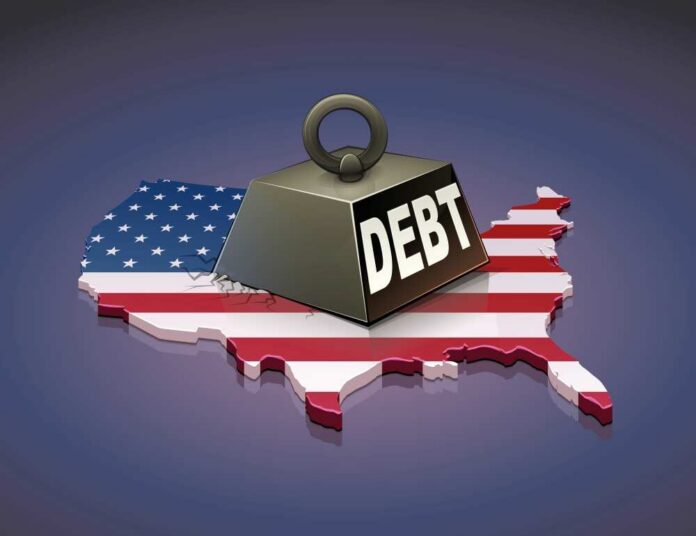
The federal government is on pace to borrow more than $2 trillion this year, and the gap between what Washington spends and what it collects just got wider than expected.
Quick Take
- The Congressional Budget Office (CBO) now projects a $2.1 trillion deficit for fiscal year 2026, up from its earlier estimate of about $1.85 trillion.
- Through the first 10 months of the fiscal year, the deficit already totaled nearly $1.8 trillion, $169 billion more than the same period last year.
- Weaker-than-expected tariff revenue and rising refunds account for much of the $200 billion jump in the projection.
- Other agency estimates, including one from the Office of Management and Budget (OMB), land close to the same range, near or above $2 trillion.
What The Latest CBO Numbers Show
CBO’s July 2026 monthly budget report says the government ran a nearly $1.8 trillion deficit through 10 months of the fiscal year. That’s already close to last year’s full-year total. Based on that pace, CBO raised its full-year forecast to $2.1 trillion, a $200 billion jump from its February estimate.
Federal budget deficit on track to surpass $2T this fiscal year as spending outpaces revenue https://t.co/R2XsECvndx
— FOX Business (@FoxBusiness) August 11, 2026
A deficit simply means the government spent more than it brought in during the year, and the Treasury Department tracks this gap every month as part of its basic accounting of federal finances.
This year’s shortfall isn’t a one-time blip. It continues a pattern of trillion-dollar-plus deficits that has held steady since 2020, regardless of which party controlled Congress or the White House.
Why The Estimate Jumped $200 Billion
CBO says the increase mostly traces back to revenue, not new spending. Customs-duty collections, tied to tariffs, came in weaker than expected, and refunds tied to those duties rose.
Spending stayed close to what CBO had already projected. In other words, the government isn’t spending dramatically more this year than planned. It’s collecting less than it hoped.
That distinction matters. A deficit driven by falling revenue points to a different fix than one driven by runaway spending. If tariff income keeps underperforming, lawmakers face a choice between accepting bigger deficits, raising other revenue, or cutting outlays elsewhere. None of those options are politically easy in an election cycle.
Other Agencies Land In The Same Neighborhood
CBO isn’t alone in this range. Earlier this year, Treasury and OMB estimates put expected federal borrowing needs near $2 trillion as well, with OMB pegging its own deficit projection at roughly $2.065 trillion.
When three separate federal bean-counters converge on similar numbers using different models and assumptions, that convergence is itself a signal the trend is real, not a fluke of one office’s math.
The Fine Print Behind The Headline Number
Not every CBO document tells the identical story. The agency’s separate 10-year budget outlook, covering 2026 through 2036, still lists this year’s deficit at $1.9 trillion rather than $2.1 trillion, because it uses a different baseline and timing convention.
That’s a normal quirk of federal forecasting, where the same year can carry slightly different price tags depending on when the estimate was made and what it assumes about the economy.
Some reporting has also connected this year’s shortfall directly to tariff policy, noting that an expected revenue windfall from tariffs has been shrinking faster than forecasters anticipated, which alone accounts for a large chunk of the $200 billion revision. That’s a useful reminder that trade policy and budget arithmetic are tied together whether anyone intends it or not.
Why This Keeps Happening And Why It Matters
Washington has now run deficits above $1.7 trillion in each of the last several years, a stretch unmatched outside of wartime or recession. Interest payments on the national debt are climbing right alongside the deficit itself, eating into money that could otherwise fund defense, infrastructure, or tax relief. Every dollar spent servicing debt is a dollar not spent on anything voters actually asked for.
Even with tariff revenue falling short, CBO says outlays stayed roughly on pace with expectations, meaning the government didn’t tighten its belt to offset the shortfall. A household that loses income and keeps spending the same amount ends up in the same hole Washington is digging now.
The federal budget deficit totaled $1.8 trillion in the first 10 months of fiscal year 2026, the Congressional Budget Office estimates. That amount is $169 billion more than the deficit recorded during the same period last fiscal year. Revenues rose by $139 billion (or 3…
— Omar Fundora (@TheTrue2) August 10, 2026
The final FY2026 number won’t be locked in until the fiscal year closes at the end of September, and monthly Treasury statements between now and then could nudge the total up or down. But the direction is set.
Barring a surprise revenue surge or a late round of spending cuts, 2026 will mark another year where Washington borrowed more than $2 trillion just to keep the lights on.
Sources:
finance.yahoo.com, fiscaldata.treasury.gov, fortune.com, cbo.gov