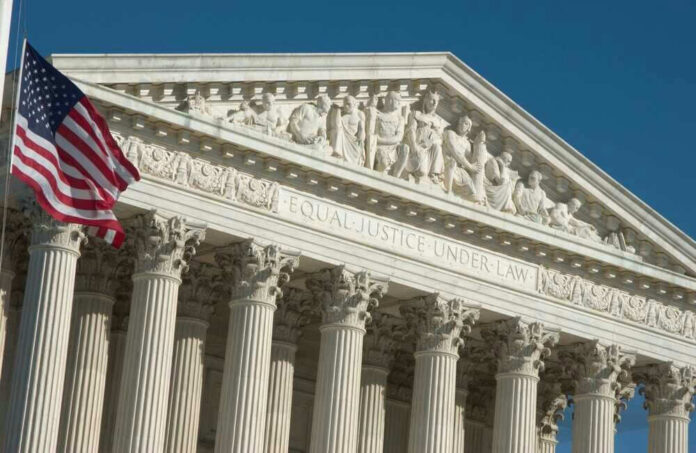
Chief Justice John Roberts just gave President Trump’s $400 million White House ballroom project a temporary green light, letting bulldozers keep working while the Supreme Court decides whether to step in.
Quick Take
- Roberts allowed construction on the $400 million ballroom to continue “for now” while the full Supreme Court weighs an emergency request.
- A federal appeals court had ruled 2-1 that only Congress can authorize the project, not the president acting alone.
- The National Trust for Historic Preservation says the administration has no legal power to build without Congress signing off.
- Senate Republicans, led by Lindsey Graham, are pushing a bill to formally fund and authorize the ballroom.
What The Chief Justice Actually Decided
Roberts did not settle the fight. He issued a short administrative stay, a routine move that keeps things frozen while the full Supreme Court reviews the Trump administration’s emergency request.
Work on the 90,000-square-foot ballroom, built where the East Wing once stood, can continue in the meantime. The order carries no ruling on who is right. It simply buys time for nine justices to look at the case.
Supreme Court chief justice allows work on Trump’s $400M White House ballroom to continue for nowhttps://t.co/4HBmPx7mKM
— Phil Stripling (@civex) August 21, 2026
That request landed at the court just one week after the U.S. Court of Appeals for the District of Columbia Circuit ordered the project halted.
Trump’s solicitor general asked the justices to let construction proceed during the appeal, arguing the lower court’s order threatened an ongoing, expensive project mid-stream. The administration frames a pause as the real disruption, not the building itself.
Why Judges Keep Ruling Against The White House
The appeals court’s 2-1 opinion was blunt. Judges Patricia Millett and Bradley Garcia wrote that the Constitution’s Property Clause gives Congress control over federal property, and that a president is “a temporary tenant, not the owner” of the White House.
They said the massive ballroom is a decision for lawmakers, not something the executive branch can push through on its own.
That appellate ruling upheld an earlier injunction from Senior U.S. District Judge Richard Leon, who found in March that Trump could not proceed without congressional approval.
Leon had also rejected the administration’s attempt to justify the entire project as a national security necessity, ruling that argument did not cover the scope of what was being built.
The Preservation Group Driving The Lawsuit
The National Trust for Historic Preservation, the nonprofit behind the legal challenge, has stayed on message throughout. Its president, Brent Leggs, said after the appellate win that the group’s position has been “clear and consistent” since the start: only Congress can authorize construction of a ballroom at the White House.
In its Supreme Court filing, the Trust went further, stating the administration has “no unilateral legal authority—constitutional, statutory, or otherwise” to build on the demolished East Wing site unless Congress expressly approves it.
The group has also pushed for the normal review process, including sign-off from the National Capital Planning Commission and the Commission of Fine Arts, before any shovel touches the ground.
Congress Tries To Solve It With A Bill
Rather than wait on the courts, Senate Republicans are trying to make the legal fight moot. Lindsey Graham, chairman of the Senate Budget Committee, introduced the White House Safety and Security Act of 2026, which would appropriate the full $400 million directly to the president for the project.
Graham has framed it partly as a security upgrade, tying the funding push to a recent assassination attempt near the White House and describing the ballroom as anything but a vanity project.
That framing matters. If Congress passes the bill and Trump signs it, the entire legal dispute over presidential authority becomes irrelevant, because the branch the courts say must approve the project will have done exactly that.
Until then, the fight stays in front of judges, and now the Supreme Court, deciding a genuinely important question about how much power a sitting president has over the people’s house.
What Happens Next
This dispute fits neatly into a long American pattern: presidents pushing the limits of executive authority over federal property, and courts pulling them back unless Congress has clearly signed off first.
Legal scholars point to similar fights over national monuments, where major changes tend to survive only when lawmakers explicitly authorize them. Unilateral executive moves, however well-intentioned, usually end up in litigation.
For now, construction crews keep working under Roberts’ temporary order while the full Supreme Court decides whether to take the case, send it back down, or let the appellate ruling stand. An emergency stay is not a final word, and nobody should mistake it for one. But it does mean the ballroom, for the moment, is still going up.
Sources:
apnews.com, congress.gov, abcnews4.com, cnn.com, washingtonpost.com, reuters.com