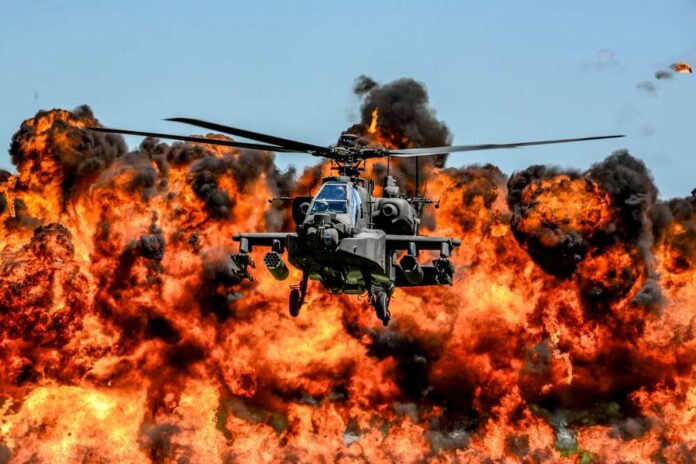
Two Fort Hood soldiers died when an Apache helicopter fell into a Texas field and turned dry grass into a wall of fire.
Story Snapshot
- The U.S. Army said an AH-64 Apache from Fort Hood crashed near Salado, killing both on board.
- Bell County deputies got a 911 call just after 1:30 p.m.; responders found a violent crash and fire.
- The crash sparked fast-moving flames and nearby evacuations; no homes were struck.
- The cause was not released at the time; Army investigators took the lead.
What Happened, Where, and When
The U.S. Army confirmed an AH-64 Apache attack helicopter from Fort Hood went down in a field near Salado on Wednesday afternoon, killing both soldiers aboard. Bell County dispatchers received a 911 call a little after 1:30 p.m., and deputies, firefighters, and medical teams rushed to the scene.
Officials at the site described a forceful impact and a wreck area that showed little chance of survival. The aircraft did not strike homes, but the crash area sat close to neighborhoods and ranch land.
Two people were killed when a U.S. Army Apache helicopter from Fort Hood crashed in Salado, Texas, on Wednesday, local authorities said. https://t.co/dvVsSE11DW pic.twitter.com/0GpBMFBSKd
— CBS Evening News with Tony Dokoupil (@CBSEveningNews) August 12, 2026
First responders pulled lines on a grass fire that took off with the wind. Fire crews from Salado and nearby towns worked the perimeter and protected homes. Law officers closed roads as smoke reduced visibility.
Evacuations began as a safety step while crews tried to box the flames. The fire complicated early work by investigators and created a larger risk zone. Local leaders warned drivers to avoid the area so engines and tankers could move freely.
Who Said What, And Why It Matters
Army officials identified the helicopter as a two-seat Apache based at Fort Hood and stated both soldiers died in the crash. The Bell County Sheriff’s Office confirmed the deaths and the timing of the first calls.
A sheriff’s spokesman described the crash as violent, a detail that matched the debris pattern and the fire behavior seen on live feeds. National outlets repeated those facts, which lined up across reports on the aircraft type, location, and loss of life.
These statements carry weight because they come from people with direct roles. The Army owns the aircraft and the duty to notify families and lead the probe. The sheriff’s office runs the 911 system and controls the scene until federal teams arrive.
When both agree on the basics, most readers can trust the core facts while waiting for the technical cause. That is the right balance: sober about what is known, clear about what is not yet known.
What We Don’t Know Yet
The cause remained under investigation at the time of reports. Mechanical failure, pilot disorientation, bird strike, or training risk are all general possibilities in military aviation. None can be claimed here without the accident board’s findings.
The Army’s safety and criminal investigators usually review maintenance logs, flight plans, weather, and any data cards pulled from onboard systems. That process takes time and often arrives in stages, from a short update to a full report months later.
Some early numbers also tend to shift in events like this. Acreage burned, containment levels, and exact times can change as crews map the scene and debrief.
That does not change the anchor facts: an Apache from Fort Hood crashed in a field, two soldiers died, and a grass fire followed. Responsible reporting sticks to those anchors and avoids guesswork about root causes before specialists speak on the record.
Risk, Readiness, and Respect
Army aviation runs hard missions in rough conditions because the nation asks it to. Training for war brings danger even on clear days close to home. Apache pilots carry heavy workloads: low-level flight, night work, gunnery practice, and complex crew tasks.
Local leaders kept the public safe during the fire and gave space for the military teams to work. That mix of duty and discipline is how communities near bases live well with risk while supporting those who serve.
Officials with Fort Hood confirmed that the crash in Salado involved an AH-64 Apache attack helicopter based at the installation. https://t.co/IGDavtoQ0L
— THV11 (@THV11) August 13, 2026
The public interest lies in a clear chain of accountability, not in blame for its own sake. When the Army releases findings, judge them by specifics: parts history, training records, weather data, and cockpit procedures. If the facts show a gap, close it. If they show strong practice, keep it.
Sources:
cbsnews.com, abcnews.com, cnn.com, youtube.com