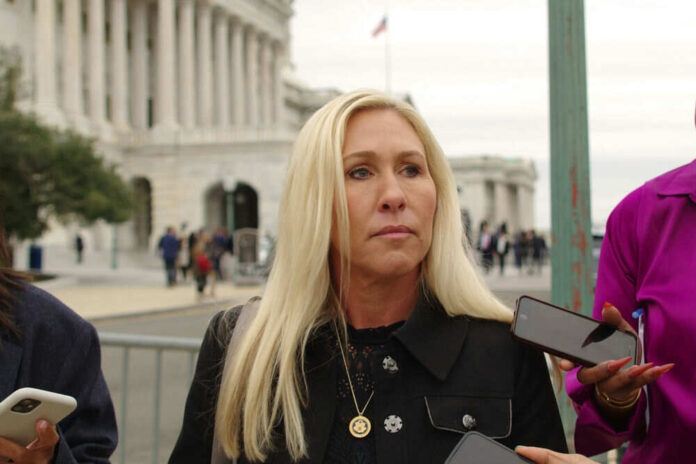
Exposing a deepening rift within the Republican Party and putting America’s priorities under a blinding spotlight, Rep. Marjorie Taylor Greene’s move to strip all foreign aid for Israel from the latest defense bill has thrown Congress into chaos.
At a Glance
- Rep. Greene is demanding the removal of $500 million in aid to Israel from the 2025 defense bill.
- This gambit has sharpened divides among Republicans, pitting “America First” voices against the party’s establishment hawks.
- Greene’s push aligns with a growing isolationist sentiment among both the far right and far left, marking a rare moment of cross-ideological agreement.
- The outcome could shake U.S. foreign policy, future aid debates, and our global alliances.
Greene’s Crusade: America First, Foreign Aid Last
Rep. Marjorie Taylor Greene (R-GA) is once again lighting a fire in the halls of Congress, this time by vowing to gut the 2025 defense appropriations bill of all foreign aid earmarked for Israel. Her proposed amendment would eliminate $500 million meant for Israeli missile defense, alongside similar cuts for Taiwan, Jordan, and overseas humanitarian projects.
Greene insists that every last dime should be spent shoring up America’s own border, not bailing out foreign governments. As she trumpeted across social media and conservative media platforms, “America’s defense bill should defend America—period.” For the millions of taxpayers watching their dollars evaporate into the latest crisis overseas, her message is hitting a nerve.
This isn’t just another headline-grabbing stunt. Greene’s crusade is forcing uncomfortable conversations inside the GOP, challenging the old-guard’s knee-jerk support for foreign aid. Her defiance even puts her at odds with Donald Trump, who remains a staunch backer of robust military support for Israel. For a party that’s long prided itself on unity around defense and support for allies, the cracks are impossible to ignore.
A Republican Rift on Israel: Hawks vs. Isolationists
The Republican Party is coming apart at the seams over this one. On one side stand the traditional hawks: pro-Israel, pro-intervention, and ready to sign the next aid package with barely a glance. On the other are Greene’s “America First” insurgents, who want to slam the door on endless foreign entanglements and focus on the mess at home.
As the Israel-Iran conflict flares, these divisions have sharpened. The defense bill now sits at the center of a high-stakes tug-of-war—one that could delay government funding, risk a shutdown, and strain relations with some of America’s closest partners.
While Greene’s amendment faces an uphill climb—given bipartisan support for Israel remains strong—the mere fact that these debates are happening so loudly is a sign of how much the ground has shifted.
The American public’s patience for writing blank checks to foreign governments is wearing thin, especially after decades of costly wars and a southern border crisis that Washington seems determined to ignore. Greene’s move taps into this frustration, playing to voters who see foreign aid as a luxury America can no longer afford.
Bipartisan Skepticism and the Unlikely Alliance
It’s not every day that the far right and far left find common cause, but Greene’s push has pulled some progressive Democrats into her orbit—at least on the subject of foreign aid. Both factions argue that every dollar sent overseas is a dollar not spent on American families, border security, or veterans.
The result is a rare and awkward alliance, with the establishment center of both parties scrambling to hold the line. This moment of bipartisan skepticism could set a new precedent: future aid packages may face far more scrutiny, and the days of rubber-stamping billions for allies might be numbered.
For Israel, Taiwan, and Jordan, the uncertainty is no joke. Even the suggestion that U.S. support could dry up sends ripples through their defense planning and diplomatic overtures.
For the contractors and industries that profit from foreign military sales, the threat of reduced business is real. And for the average American, the hope—maybe naïve—is that less spending abroad might mean more investment at home. That’s the promise Greene is selling, and plenty of voters are buying.
Long-Term Consequences: America’s Place in the World
If Greene’s gambit gains traction, the shockwaves will travel far beyond this year’s budget cycle. Allies who once counted on unwavering U.S. support could find themselves looking elsewhere.
The next time a crisis erupts overseas, Congress may not be so quick to open the checkbook. On the home front, the GOP’s internal battles could reshape the party for years to come, as “America First” isolationists wrestle with the old-guard interventionists for the soul of the movement.
Yet, for all the sound and fury, the odds of a dramatic aid cut this year remain slim. The establishment still holds the cards, and most lawmakers aren’t ready to upend decades of foreign policy on a single vote.
But Greene’s campaign is a shot across the bow—a warning that the old rules no longer apply, and that the American people are tired of being told their priorities come second to someone else’s war. Whether or not she wins this round, the debate she’s forced will echo through Congress for a long time to come.