

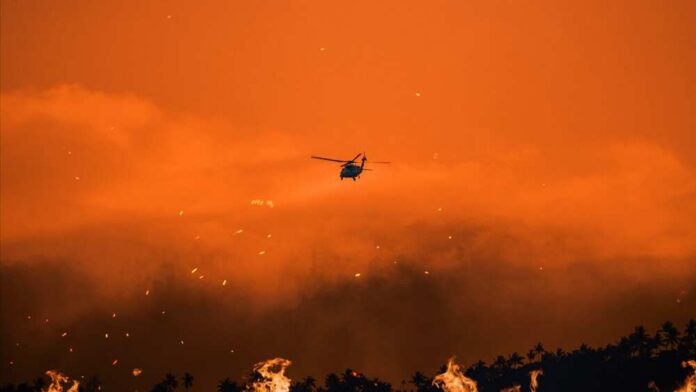
Two men flew a giant helicopter into Utah’s wildfire smoke to save strangers, and never came back.
Story Snapshot
- Two pilots died when a Sikorsky Skycrane helicopter crashed while fighting the Widemouth 2 Fire in central Utah.
- The heavy-lift aircraft was working under a United States Forest Service contract to support wildfire crews on the ground.
- Federal investigators from the National Transportation Safety Board and Federal Aviation Administration are now examining what went wrong.
- The crash highlights both the quiet heroism of aerial firefighters and the growing strain of America’s wildfire season.
What Happened Over The Widemouth 2 Fire
The crash began like any other mission. A Sikorsky S-64 Skycrane heavy-lift helicopter launched around midmorning to support crews on the Widemouth 2 Fire burning in central Utah’s Fishlake National Forest.
The aircraft, contracted to the United States Forest Service, had two people on board as it worked near the south end of the fire line. Around 10 a.m., the helicopter went down near Richfield, Utah, and a post-crash fire followed.
Officials provided updates on the helicopter crash that killed two firefighters assigned to the Widemouth 2 Fire, confirming that they were able to recover the victims from the crash site on Saturday.
More details: https://t.co/d5siGdoo4v pic.twitter.com/gdSWURXva7
— ABC4 News (@abc4utah) August 9, 2026
Local officials reached the site as fire behavior and terrain allowed. Sevier County authorities confirmed that both pilots died in the crash. Fire managers described the helicopter as part of the suppression effort, not a side flight or transit leg.
Officials stressed that the cause of the accident is unknown for now, and warned against early armchair theories while investigators work the scene and review flight data.
Who The Pilots Were And What They Were Doing
The Skycrane crew was not flying tourists or cargo; they were flying into heat and smoke to protect people they would never meet. The helicopter was on an aerial firefighting mission, lifting water or retardant to help ground crews hold fire lines around the Widemouth 2 Fire.
A Skycrane can move huge loads, so every trip can slow a wall of flame that might otherwise overrun homes, ranches, and small towns stitched across central Utah’s valleys.
Family members and colleagues described the pilots as experienced aviators used to long, dirty shifts over disaster zones. Statements from fire officials framed them as part of a larger team that includes hand crews, engine crews, and local sheriffs trying to keep a dangerous fire from growing even larger.
How The Investigation Will Unfold
The National Transportation Safety Board and the Federal Aviation Administration opened an investigation into the crash, as they do after every serious aviation accident.
Investigators will study the wreckage near Three Creeks Reservoir, analyze maintenance records, examine pilot training and duty schedules, and consider weather, terrain, and fire conditions at the time of the crash. A preliminary report will likely arrive in weeks, but a full explanation may take a year or more.
That delay often frustrates the public, but it reflects the tradeoff between speed and accuracy. Careful reconstruction beats hot takes. That patient approach also protects the pilots’ families from wild claims that might blame them without proof.
The Hidden Risk Of Aerial Firefighting
Helicopters like the Sikorsky Skycrane are marvels of practical engineering, built to lift heavy loads in thin, hot air where other machines struggle.
But no amount of engineering removes risk when you hover low over steep ground, near rising columns of heat and smoke, with fire churning just below the rotors. Wildland pilots fly close to their performance limits because that is where the job lives.
Two helicopter pilots were killed when their Sikorsky Skycrane crashed while battling a wildfire in Utah’s Fishlake National Forest, officials confirmed Saturday. https://t.co/L4kJsOa3TS
— FOX 4 NEWS (@FOX4) August 10, 2026
Wildfire aviation accidents are not common, but they are regular enough to remind us that safety margins are thin. Each crash forces hard questions: Was the mission necessary at that moment? Was the aircraft maintained to standard? Did pressure to hold the line against a fast-moving fire nudge anyone to take extra risk?
Those questions are not attacks on the pilots. They are how a serious country honors sacrifice by learning from it.
What This Says About Wildfire Policy And Priorities
The Widemouth 2 Fire and the loss of this Skycrane crew show how much we now ask of a small group of wildfire professionals. As fires burn hotter and faster across the West, agencies lean more on high-cost, high-risk aviation assets to protect homes built deeper into wildfire country.
Many Americans argue for a three-part response. First, give firefighters and pilots the gear, training, and maintenance budgets they need, before the fire starts. Second, enforce basic land-management practices that reduce fuel loads so every fire does not turn into a major air campaign.
Third, tell the truth about risk. Not every cabin built in a tinderbox canyon can be saved in every wind pattern, and pretending it can only drives crews to push into danger that no mission can justify.
How We Remember Sacrifice Without Romanticizing Death
Local coverage, social media posts, and agency statements all emphasized the pilots’ courage and service. That is right and decent. But real respect does not stop at kind words and flag-draped escorts down the highway.
It also means fixing what can be fixed, and refusing to let a “hero” label hide preventable failure in planning, policy, or oversight. American families who send loved ones to dangerous work have a right to expect that bargain.
There is a quiet lesson here for the rest of us as well. Most people who will sleep safely this summer will never hear rotor blades or smell the smoke these pilots flew through. Yet their safety rests, in part, on men and women who launch when others evacuate.
The least we can do is pay attention, stay curious until the facts are in, and demand that leaders value those lives.
Sources:
apnews.com, aljazeera.com, ndtv.com, kutv.com, justthenews.com, facebook.com, reddit.com, deseret.com, x.com, stgeorgeutah.com