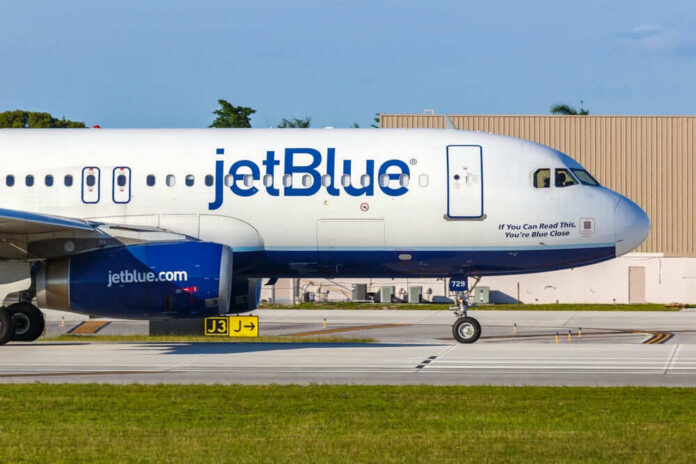
A JetBlue pilot says a drone slammed into his jet at 3,000 feet over New York.
Story Snapshot
- Pilot reported a midair drone strike above the cockpit while landing at John F. Kennedy International Airport
- Federal Aviation Administration and JetBlue inspections found no damage and no proof of impact
- If confirmed, this could be one of the first drone collisions with a United States passenger jet
- The clash exposes a bigger fight over pilot trust, drone risks, and who America chooses to believe
The moment a pilot said a drone hit his jet over New York
Just after 7:15 a.m., JetBlue Flight 948 from Las Vegas dropped toward John F. Kennedy International Airport through a busy slice of sky over the Atlantic coastline.
As the Airbus A321 crossed roughly 3,000 feet, the captain keyed his radio and calmly told air traffic control, “We collided with a drone back there in the turn… it hit us right above the cockpit.” The tone was matter of fact, not panicked. He did not ask for help. He simply reported what he believed he had just lived.[2][6][7]
The jet continued its approach and landed minutes later at 7:21 a.m., with passengers unaware anything unusual had happened. On the ground, people walked off the plane as they always do.
No emergency crews rushed up. No one saw a dent, a crack, or burned plastic on the nose. JetBlue pulled the aircraft from service, as safety rules demand, and sent mechanics crawling over the skin and systems to look for any sign that a drone had kissed the cockpit.[2][4]
The official story: serious report, zero hard evidence so far
Federal Aviation Administration officials quickly confirmed the pilot’s report and launched an investigation. Agency staff described the event as a “reported strike” at about 3,000 feet on final approach, north of the New Jersey beach town of Sea Bright, roughly 10 to 12 miles from the airport. JetBlue backed this up.
The airline said the crew “reported a possible drone encounter,” and that the aircraft had been removed from service for a full post flight inspection. On paper, the system took the pilot at his word and moved into high gear.[1][2][3][4]
A JetBlue pilot reported their plane possibly struck a drone at 3,000 feet while on final approach to John F. Kennedy International Airport. The plane landed safely, and all passengers were able to exit normally. https://t.co/OirVItoMia pic.twitter.com/JlqKgCnToK
— CBS Evening News with Tony Dokoupil (@CBSEveningNews) June 29, 2026
Then the inspection results came back. JetBlue’s statement was blunt: the exam “found no damage or evidence of a collision.” Federal Aviation Administration officials echoed that finding.
No cracked composite panels above the cockpit. No chipped windshield. No embedded battery. Nothing you would expect from a drone hitting a commercial jet at more than 150 miles per hour. If this was a strike, it left no obvious trace. That mismatch between what the pilot felt and what engineers could see is now the heart of the case.[1][2][4]
Why a “phantom strike” matters far beyond one JetBlue flight
Drone hits on passenger jets are not just rare. Policy research argues no commercial drone or hobby quadcopter has ever been clearly confirmed to collide with an airliner in United States airspace. A review of collisions between drones and aircraft worldwide found only a handful of confirmed events, with many more stuck in the “suspected” bucket because evidence was thin.
When engineers do test impacts, models show that even a small drone can damage an airplane’s nose, structure, or engine blades. That makes a clean inspection after a supposed hit a very big deal.[12][14][16]
🚨 #BreakingNews 🚨
"JetBlue Flight 948 Reports Mid-Air Drone Strike on Final Approach to JFK Airport; FAA Launches Investigation After Airbus A321 Lands Safely With No Damage"
➡️ JetBlue Flight 948, an Airbus A321 traveling from Las Vegas to New York City, reported a direct… pic.twitter.com/eD8E5UxxIw— BreakinNewz (@BreakinNewz01) June 29, 2026
The law treats real drone strikes as serious business. Legal analysis notes that if a midair collision occurs during a commercial drone operation, the operator and their company can face major civil costs and government penalties. That includes paying for aircraft repair, covering injuries, and even losing licenses or equipment.
Add that pressure to the fact that drones are barred from flying near airports, and you see why nobody in the drone world wants this case to end with “confirmed collision.” For regulators, proof of a hit could also trigger tougher limits on everyday drone owners.[10]
The fight over whom to trust: pilots, engineers, or statistics
For many Americans, airline pilots still rank high on the list of people they trust. A captain saying “we collided with a drone” sounds like an eyewitness report, not rumor.
Common sense says you do not dismiss the man at the controls, alone in a crowded sky, who has skin in the game if he is wrong. At the same time, the facts so far point to no damage and no physical proof, even after careful checks. That forces a hard question: can both the pilot and the inspection team be right?
One possibility is misidentification. Along coasts, birds, balloons, and even trash can look strange at high speed and odd angles. Aviation safety data already shows thousands of bird strikes a year, while drone collisions remain extremely rare. In that context, experts lean toward caution about every drone story until hard evidence appears.
The Federal Aviation Administration should resist media pressure and social media noise and keep asking for radar records, surveillance footage, and detailed engineering reports before rewriting rules or shaming pilots.[12][18]
What this strange case says about future drone risks
The JetBlue report joins a pattern of “unverified strikes” where a pilot describes a drone hit, the airplane lands safely, and mechanics find nothing wrong. Each time this happens, the gap between fear and fact grows.
Drone rules near airports should be enforced and, when needed, strengthened. People who break them should pay real penalties, as current law already allows.
Yet national policy should rest on facts that hold up in daylight, not on one chilling radio call that left no mark on metal. JetBlue Flight 948 may end up as a warning not of a drone attack, but of how fast our fears can outrun the proof.[10]
Sources:
[1] Web – JetBlue flight reports striking drone while landing at JFK
[2] Web – What happened to JetBlue Flight 948? FAA investigates reported …
[3] Web – DRONE STRIKE REPORTED at JFK Airport 29 JUN …
[4] YouTube – JetBlue pilot reports striking drone as flight approached JFK Airport
[6] X – JetBlue flight 948 reported hitting a drone at
[7] Web – JetBlue flight reports drone strike near JFK, FAA investigates
[10] Web – A JetBlue flight struck a drone while approaching John F. …
[11] Web – JetBlue pilot reports hitting drone while landing at New York’s JFK
[12] Web – DRONE STRIKE REPORTED at JFK Airport 29 JUN 2026 – Instagram
[14] Web – JetBlue aircraft strikes drone on approach to New York JFK A …
[16] Web – Flight history for JetBlue flight B6948 – Flightradar24
[18] YouTube – Review of close call between commercial airliner, drone …