Drones that can pepper-spray and ram a school shooter in seconds are moving from science fiction to school policy in Florida, Georgia, and Colorado.
Story Snapshot
- At least nine schools in three states are installing pepper-spraying, strobe-flashing defense drones this year.
- The plastic aircraft are designed to be airborne in about five seconds and reach a shooter in about fifteen.
- Remote human pilots in Texas control the drones, using sirens, strobes, pepper gel, and, if needed, high-speed ramming.
- Supporters say the goal is simple: buy a crucial minute of survival time until police get there.
Schools turn to combat-style drones as a new layer of defense
Several schools across Florida, Georgia, and Colorado are about to open their doors with a new kind of security guard: a pizza-sized drone, sitting in a wall box or on a charging pad, waiting for a teacher to hit a panic button.
At least nine campuses are confirmed to be adding Mithril Defense’s Campus Guardian Angel system this year, backed by district decisions and state funding. This is not a proposal; it is being rolled out into real hallways.
Schools Are Adding Pepper-Spraying Drones to Help Combat Active Shooters, With Plastic, Non-Lethal Aircraft That Can Smash Windows and Ram Attackers Set to Be at the Ready at Certain Schools in Colorado, Florida, and Georgia 🚁🏫 pic.twitter.com/7MdYsDOFyb
— Raphousetv (RHTV) (@raphousetv2) July 29, 2026
When a staff member reports an active shooter threat through an app or panic switch, the system pushes an alert to a tactical operations center in Texas. Licensed human pilots there confirm the threat on live video and launch one or more drones.
Mithril’s targets are aggressive: airborne in about five seconds, on the suspect in about fifteen, and “degrading or incapacitating” within about sixty seconds. The whole pitch rests on beating police arrival by a wide margin.
How the Campus Guardian Angel drones are built to fight
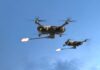
The aircraft themselves are plastic and nonlethal, but they are packed with disruptive tools. Each drone carries loud sirens, blinding strobe lights, speakers for voice commands, and a launcher that can fire pepper gel or pepper balls at a shooter.
Some versions can drop small “air poppers” that create a sharp bang to startle and distract. The nose can be fitted with a lance or glass punch to smash through standard windows and enter rooms or hallways at speed.
The drones are designed to move fast inside a school. Reports describe speeds of 50 to 60 miles per hour as they weave down corridors. The Independent cites company claims of up to 70 miles per hour for ramming strikes. If the sirens, strobes, and pepper do not stop the attacker, the drone becomes a projectile.
Mithril’s chief executive describes a last step where an operator physically rams the attacker “at speed” to prevent further killing. That image drives much of the public reaction.
Human pilots, not killer robots, call the shots
Supporters stress that this is not an autonomous weapon system. The drones stay idle until a human team at the Texas operations center confirms a credible threat and decides how to respond.
Federal Aviation Administration–certified pilots then fly the drone by camera feed, issue verbal commands, deploy pepper rounds, and choose whether to escalate to collision.
The company frames the drones as a bridge between the first frantic minute of an attack and the moment police take control. Their stated goal is to launch waves of three or four drones if needed, “keeping the shooter occupied” until officers can safely apprehend or stop them.
For many parents who feel trapped between stalled gun policy fights and rising fear, that promise to buy time hits hard. It says, “We cannot wait for Washington; we are going to fight back now.”
Real-world testing, unanswered questions, and values at stake
The hard truth is that these systems have only been used in drills and simulations so far. No public record shows a Campus Guardian Angel drone reducing casualties in an actual school shooting.
Journalists covering the rollout note there is “zero empirical data” that the drones outperform basics like locked doors, trained staff, or more officers on campus. The key timelines and incapacitation claims still come mainly from the vendor, not from independent live-fire trials.
At least nine U.S. schools in Florida, Georgia and Colorado are being equipped with pepper-gel spraying drones from Austin, Texas-based Mithril Defense to help distract active shooters until police arrive.
— NTC Report (@NTC_Report) July 29, 2026
Safety advocates and consultants raise practical concerns. Pepper spray in a tight hallway can hit students, teachers, or even responding officers who rush in. A misidentification during chaos could send a drone after the wrong person.
Critics also worry that adding combat-style machines into schools feeds a dystopian feel and diverts money away from prevention, mental health, and stronger building security. These worries line up with a broader pattern: technology races ahead of proof.
Where the debate goes next
For now, the drones will launch in select districts as state-funded pilots. Georgia high schools alone may host twenty to sixty drones apiece in wall boxes, part of a program costing around half a million dollars across five campuses.
Supporters argue that some action is better than more talk, and that nonlethal, American-designed tools are a more realistic answer than sweeping gun bans many communities reject. That view tracks closely with priorities of self-defense, local control, and hardening targets.
The next phase will decide whether this becomes a standard tool or a short-lived experiment. Independent trials that measure response times, injuries, collateral exposure, and police coordination would give parents and taxpayers real numbers instead of slogans.
School board members now face a hard question: in the face of evil acts that unfold in under a minute, is it wiser to send a fast drone with pepper spray, or to invest all limited resources in doors, people, and prevention? Voters will answer that, one district at a time.
Sources:
cbsnews.com, washingtonpost.com, theguardian.com, youtube.com, yahoo.com, cleveland.com, aol.com, washingtontimes.com, independent.co.uk, dronelife.com