A 19-year-old high school senior lit a sleeping homeless man on fire on a New York City subway, and still walked away with barely more than five years in prison.
Story Snapshot
- Teen arsonist used a piece of paper to burn a homeless man on a moving subway car[3]
- Prosecutors said he tried to kill the victim by trapping him in flames on the train[3]
- Federal judge gave 5½ years, just above the mandatory minimum for arson[3]
- Case exposes rising subway violence and soft, confusing justice for brutal crimes[7]
A homeless man burned alive on a six-minute subway ride
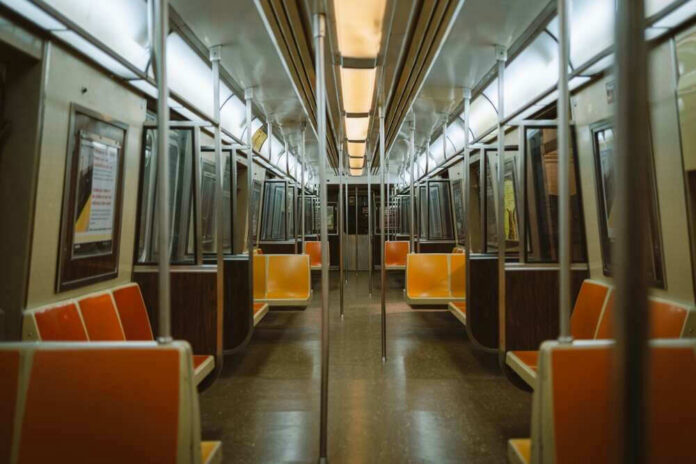
Around 3 a.m., a 56-year-old homeless man slept on a northbound No. 3 train near 34th Street–Penn Station in Manhattan[9]. Eighteen-year-old high school senior Hiram Carrero stepped briefly into the car, lit a piece of paper on fire, and dropped it near the sleeping man[9].
As the train rolled toward Times Square, the flames spread and engulfed the victim’s legs and much of the car. He stumbled out at 42nd Street, his lower body on fire, as police rushed to extinguish the blaze[9].
High School Senior Who Set Sleeping Man on Fire on N.Y.C. Subway Sentenced to More Than 5 Years https://t.co/gyhI4sQJCo
— People (@people) June 24, 2026
New York Police Department officers quickly launched a manhunt, releasing surveillance footage that showed the suspect entering and leaving the train moments before the attack[15].
The victim, badly burned, was rushed to the hospital in critical condition but survived with permanent, severe scarring[3].
Police later arrested Carrero, a Manhattan resident, and charged him with attempted murder, multiple counts of assault, arson, criminal mischief, and reckless endangerment[2]. The images of a burning man stumbling onto the platform turned a routine subway ride into a literal horror scene.
From state arrest to federal arson case
What started as a New York Police Department arrest quickly shifted into a federal case. Within days, federal prosecutors charged Carrero with arson resulting in injury to another person, a serious federal offense because the subway system receives federal funding and falls under federal jurisdiction[9][10]. This specific charge carries a mandatory minimum of 7 years and a maximum of 40 years in prison [11].
The move signaled that authorities viewed the attack not as a minor fire, but as a targeted act of violence against a vulnerable person in public transit.
During early hearings, a federal prosecutor described the crime as an effort to kill “a sleeping, homeless man by burning him alive and leaving him trapped on a moving subway car”[3].
Video inside the car backed that narrative, showing the fire flaring up as the train traveled, then engulfing the victim’s legs before he escaped at Times Square[7].
That is not a prank gone wrong. That is a sequence of deliberate acts: boarding, lighting paper, placing it near a sleeping man, and jumping out just as the doors closed[9]. Common sense says you know exactly what fire does in a closed metal box.
The guilty plea and a five-and-a-half-year sentence
In March 2026, Carrero pleaded guilty to the federal arson charge, admitting that he intentionally ignited a piece of paper that harmed the man[3][11].
On June 23, 2026, U.S. District Judge Lewis J. Liman sentenced him in Manhattan federal court to 66 months—five and a half years—in prison, followed by three years of supervised release and restitution payments[3][8][11].
Prosecutors had urged up to eight years, arguing that his “heinous actions” left the victim critically injured and permanently disfigured[3]. The judge chose a sentence slightly above the minimum, but still far below the maximum allowed.
Defense attorneys pushed a different picture. They noted that Carrero lived with his disabled mother and served as her primary caregiver, implying heavy stress and responsibility on a teenager[4].
They also pointed out that he did not stay to watch the fire spread; he lit the paper and fled, which they framed as an impulsive act, not a long-planned murder plot[9].
For many Americans, that raises a hard question: how far should personal hardship and youth bend the punishment for a crime that leaves a man burned from the waist down?
Violent transit, vulnerable victims, and uneven outrage
This case lands in the middle of a troubling trend. New York City data show subway assaults have tripled since 2009, with violent attacks—not simple theft—driving the increase[7].
A federal arson case over a single burning man sounds extreme until you realize it is one of several incidents where people were set on fire on public transit across the country[3].
Riders now worry less about fare evasion and more about unpredictable violence in confined spaces, especially late at night.
🗽 🚆 🔥 #MTA_horror
High school senior gets over 5 years in prison for setting a homeless man on fire on NYC subway.
Hiram Carrero, 19, pled guilty, said he'd been drinking & smoking weedhttps://t.co/rDxnc3gBqB— Mae_Westside ✍️ 🗽👻 (@Mae_Westside) June 24, 2026
The victim’s status as a homeless man cuts both ways. Media headlines never let you forget he was homeless[2][9]. That can sadly reduce empathy in some readers, but it also highlights the cruelty of targeting someone already at the bottom.
From a law-and-order view, the facts line up clearly: a young, able-bodied man turned a sleeping, unarmed, homeless rider into a human torch, then walked off the train.
A sentence barely above five years feels light compared to forty possible years and a mandatory minimum of seven that prosecutors cited[11]. When justice shrinks like that, regular riders and law-abiding citizens are the ones left to wonder how safe their commute really is.
Sources:
[2] Web – NYC teen charged with setting homeless subway rider on fire, police …
[3] Web – A high school senior who admitted to setting a fire that severely …
[4] YouTube – Man sentenced after allegedly setting NYC subway rider on fire
[7] Web – A teenager is facing federal charges for allegedly setting a sleeping …
[8] Web – Teen Charged for Setting Homeless Man on Fire in Subway Horror …
[9] Web – 18-year-old charged with arson for setting subway passenger on fire …
[10] Web – A 19-year-old man was sentenced to five-and-a-half years in prison …
[11] Web – High school senior, 18, charged with arson after New York subway …
[15] Web – A man who set fire to a sleeping subway rider last year was …