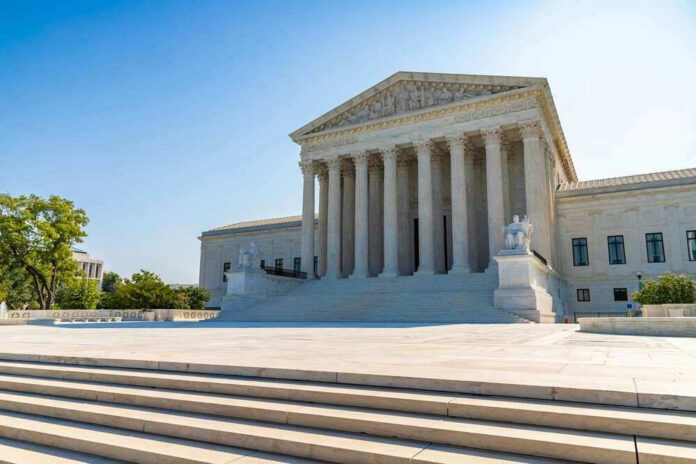
The Supreme Court just turned a missing-child cold case into a blunt warning about how hard it is to undo a state criminal conviction in America.
Story Snapshot
- The Supreme Court reinstated Pedro Hernandez’s murder conviction for the 1979 disappearance of 6-year-old Etan Patz.[4]
- The justices did not re-try the facts; they slapped down a federal court that questioned the jury instructions.[4]
- The case rests almost entirely on Hernandez’s disputed confessions, with no body and no physical evidence.[11]
- The ruling shows how a 1996 federal law now lets state verdicts stand even when serious doubts remain.[4][21]
How a missing boy reshaped childhood and the justice system
Etan Patz vanished on his way to a New York City school bus stop in 1979 and never came home.[8] His face later appeared on milk cartons across America, and his disappearance helped spark National Missing Children’s Day.[8]
Parents started walking kids to school, locking doors, and watching strangers more closely. The case became a symbol of fear, but also of faith that the system would eventually find the truth. That faith is now tangled up with the story of Pedro Hernandez.
Decades after Etan vanished, Hernandez, a quiet store worker with a low IQ and a history of mental health problems, confessed to killing the boy.[11][16] Police and prosecutors treated those confessions as the breakthrough everyone had waited for.
A first jury in 2015 deadlocked after months of testimony. A second jury in 2017 listened to 66 witnesses, weighed expert battles over mental illness and false confessions, and convicted Hernandez of kidnapping and murder.[3][8] He was sentenced to 25 years to life in prison.[2]
Why a federal court said the trial went off the rails
The real legal earthquake came years later, when a federal appeals court looked not at the evidence, but at the judge’s answers to a confused jury.[1][11] During deliberations, jurors asked a hard question: if Hernandez’s first, pre-Miranda confession was involuntary, did that mean they had to throw out his later, videotaped confessions too?[4][5]
The trial judge gave a one-line answer: “the answer is no.”[4] The Second Circuit said that reply flatly contradicted Supreme Court law and was “manifestly inaccurate,” and it ordered a new trial or release.[11]
The appeals judges focused on a basic point any juror would understand. If officers squeeze out one bad confession before reading rights, later confessions can be tainted.[11]
Jurors needed clear guidance about when they could rely on any of Hernandez’s statements. Instead, they were told they did not have to disregard the later confessions, with no explanation of why.[4] To the Second Circuit, that mistake was not a small error; it struck at the heart of a case built almost entirely on confessions.[11][16]
How the Supreme Court used Etan Patz to tighten the screws on appeals
New York prosecutors appealed to the Supreme Court, arguing the Second Circuit had taken too much power into its own hands.[4] In a 6–3 decision, the Court agreed and reinstated the conviction.[4] The unsigned majority did not say the trial was perfect. Instead, it leaned on a 1996 federal law that sharply limits when federal judges can disturb state convictions.[4][21]
Under that law, called the Antiterrorism and Effective Death Penalty Act, federal courts can grant relief only if the state court’s ruling is not just wrong, but unreasonably wrong under clearly established Supreme Court precedent.[21][22]
The majority’s message was blunt: federal courts are not supposed to second-guess state courts simply because they doubt the evidence or dislike a jury instruction.[4][9] The opinion noted that the Second Circuit seemed deeply skeptical of Hernandez’s confessions, but said the statute does not allow federal judges to overturn a conviction based on their own view of reliability.[9]
From a rule-of-law perspective, that fits a long trend. Crime is judged close to home, in local courts, and federal judges must respect those decisions unless the legal error is extreme.[21]
Confessions, mental illness, and the risk Americans should care about
Beneath the legal jargon sits an uncomfortable fact: the state’s case against Hernandez consists entirely of his confessions.[16] There is no body, no physical evidence, and no eyewitness who saw Etan with Hernandez.[11][13]
Defense experts and civil-liberties advocates argue Hernandez had a long history of mental illness, a low IQ, and hallucinations, and that his confession followed an unrecorded seven-hour interrogation in New Jersey that violated local recording rules.[12][11] CBS and other outlets highlight how mental health evaluations raised doubts about whether he could separate reality from fantasy.[14]
The Supreme Court has reinstated the conviction of Pedro Hernandez for the 1979 kidnapping and murder of six-year-old Etan Patz in New York City. https://t.co/a0mfMIgVUp
— NewsRadio WHAM 1180 (@WHAM1180) June 23, 2026
Prosecutors brought their own experts who said Hernandez was exaggerating or faking mental illness and that his earlier, quiet church confessions were not the product of psychosis.[8] A New York jury believed the prosecution and found guilt beyond a reasonable doubt.[8]
From a common-sense view, that matters: local jurors heard from both sides for five months and made a decision about community safety and justice for a murdered child.[3] The Supreme Court’s ruling backs that local judgment and resists distant second-guessing.
What this ruling means for future defendants and for trust in verdicts
The Etan Patz decision tells future defendants something hard but clear: if a state court has already weighed your arguments, federal relief is now a very steep hill to climb.[4][21]
Even serious trial errors like muddled jury instructions on the only evidence that matters may not be enough if state judges have signed off. That protects finality and prevents endless retrials that drain taxpayers and re-traumatize victims’ families. It also means innocent people caught in thin, confession-driven cases have fewer tools left.
For many Americans, this case ends as a story of closure. The boy whose face once stared back from milk cartons now has a legally firm conviction attached to his name.[8][7] But for those who worry about false confessions, mental illness, and police pressure, it is also a warning.
The system now places enormous trust in state courts and juries, even when the record is murky and the evidence is almost all words. That trade-off may fit values of order and limited federal power, but it demands one thing in return: local justice systems must earn that trust, every single time.
Sources:
[1] Web – Supreme Court Reinstates Murder Conviction in Notorious NYC Missing …
[2] Web – Hernandez v. McIntosh, No. 24-1816 (2d Cir. 2025) – Justia Law
[3] Web – Conviction overturned in Etan Patz case – AP News
[4] Web – Prosecutors ask US Supreme Court to restore conviction in Etan …
[5] YouTube – Etan Patz case: Hearing set for Pedro Hernandez ahead of retrial
[7] Web – Docket for 25-748 – Supreme Court
[8] Web – Pedro Hernandez (Etan Patz Case) – The New York Times
[9] Web – Conviction in Patz Kidnapping/Murder Highlights Limits of False …
[11] Web – Psychiatrists Offer Theories About Suspect in Patz Case
[12] Web – Court Overturns Pedro Hernandez’s Conviction in Etan Patz Case
[13] Web – Lack of Recorded Interrogation Could Affect Trial of Etan Patz Case
[14] YouTube – Man convicted in Etan Patz’s murder must have new trial …
[16] Web – Etan Patz Case: Pedro Hernandez’s Mental Health, Confession …
[21] Web – [PDF] Reversal of Criminal Cases in the Supreme Court of California, …
[22] Web – Who Killed Habeas Corpus? | ACS – American Constitution Society