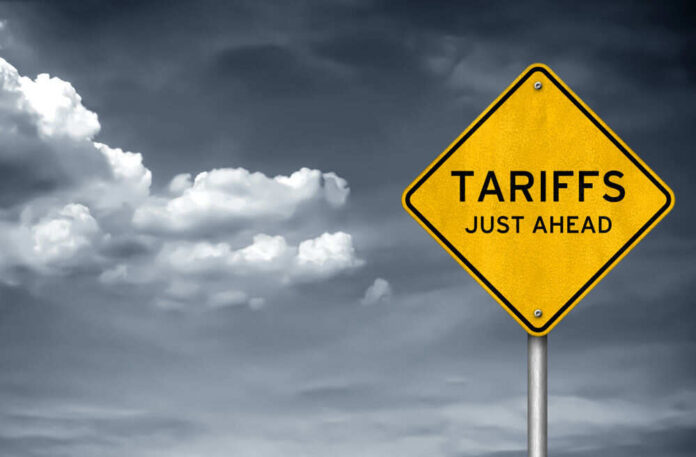
President Trump’s tariff strategy faces early challenges as Goldman Sachs reveals American consumers are absorbing 55% of the costs, sparking debate over the administration’s promise that foreign exporters would bear the burden.
Story Overview
- U.S. consumers shouldering 55% of tariff costs after six months, according to Goldman Sachs analysis.
- Consumer prices have been rising monthly since Trump’s “Liberation Day” speech in April, with CPI at 2.93%.
- White House maintains that tariffs will ultimately shift costs to foreign exporters during the transition period.
- Supreme Court tariff case scheduled for November 5 could impact business pricing strategies.
Tariff Impact Shows Mixed Results for Consumers
Goldman Sachs analysts report that American consumers are bearing 55% of tariff costs six months into President Trump’s expanded trade protection strategy.
This represents an improvement from Trump’s first-term trade war in 2018, when foreign exporters bore virtually no tariff burden, leaving consumers to shoulder nearly all costs.
The current analysis shows foreign exporters and U.S. businesses are absorbing 45% of the impact, demonstrating some progress toward the administration’s goal of shifting the burden away from American families.
U.S. consumers are already shouldering as much as 55% of costs due to Trump’s unprecedented gambit to impose sizable tariffs on imports, according to a new report from Goldman Sachs analysts. https://t.co/GO3rbr8I5L
— NBC News (@NBCNews) October 13, 2025
Inflation Pressures Continue Despite Economic Recovery Efforts
Consumer prices have increased every month since April, when Trump announced new tariffs on copper, steel, aluminum, automobiles, and auto parts during his “Liberation Day” speech.
The Consumer Price Index reached 2.93% in August, while the Federal Reserve’s preferred inflation measure climbed to 2.7%, exceeding the central bank’s 2% target.
These figures reflect ongoing challenges inherited from the Biden administration’s fiscal mismanagement, which created the inflationary environment Trump pledged to address during his campaign.
Strategic Trade Policy Aims for Long-Term American Benefits
White House spokesman Kush Desai emphasized that current tariff costs represent a necessary transition period to restore American economic independence.
The administration maintains that companies are already diversifying supply chains and onshoring production to the United States in response to the trade measures.
Trump has imposed tariff rates of up to 28% on China and 16% on other nations, targeting the unfair trade practices that put America at a disadvantage for decades under previous administrations.
Supreme Court Decision Could Reshape Business Response
American businesses may be temporarily absorbing tariff costs while awaiting the Supreme Court’s ruling on tariff authority, scheduled for oral arguments on November 5. Companies also accumulated inventory before tariffs took effect, allowing them to delay retail price increases.
However, Goldman analysts warn that the consumer burden could rise to 70% if proposed tariffs on furniture and kitchen cabinets proceed. The administration faces the challenge of balancing protective trade measures with immediate consumer relief from Biden-era inflation.