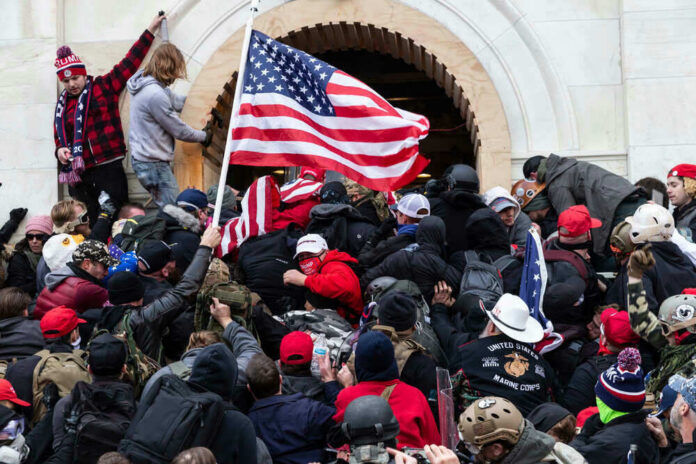
A new lawsuit by January 6 police officers says the Justice Department’s $1.8 billion “lawfare” fund turns taxpayer money into a slush fund for the very people who attacked them.
Story Snapshot
- Two officers who defended the Capitol on January 6 are suing to block a $1.776–$1.8 billion Justice Department fund tied to a Trump tax‑records settlement.
- The officers say the fund is a “corrupt sham” that could funnel taxpayer cash to pardoned January 6 rioters and other political allies.
- The administration describes it as an “anti‑weaponization” or “lawfare” fund to compensate Americans hurt by politicized prosecutions.[4]
- Courts are being asked whether the Justice Department can effectively create a massive payout program through settlement, bypassing normal congressional appropriations.[4]
What the officers are asking the court to stop
Two Washington, D.C. officers who fought to defend the United States Capitol on January 6, 2021 have filed a federal lawsuit to stop the Trump administration from moving forward with a $1.776 billion Justice Department fund. Their complaint argues the program, branded as an “anti‑weaponization” or “lawfare” fund, is structured so that people involved in the Capitol attack, including those later pardoned, could seek compensation for prosecutions they claim were politically motivated.[4]
Reports describe the fund as arising from a proposed settlement of President Donald Trump’s separate $10 billion lawsuit over the leak of his tax records, rather than from the normal budget process.[4]
Under that reported deal, Trump would drop his claim against the Internal Revenue Service and Justice Department, and the government would support creating a nearly $1.8 billion pool to pay people who say they were victims of “lawfare” by federal authorities.[4] The officers say that arrangement effectively spends public money without a clear act of Congress.
Two police officers who defended the U.S. Capitol in 2021 during the Jan. 6 attack are suing to stop the creation of President Trump's $1.7 billion "Anti-Weaponization Fund," calling it the "most brazen act of presidential corruption this century." https://t.co/vQidGHoLso
— ABC News (@ABC) May 20, 2026
How this connects to earlier January 6 legal battles
The new lawsuit lands on top of years of civil cases over January 6, many brought by officers against Trump and others they say helped spark the attack.[1][3][6] Capitol Police officers have sued Trump under the Ku Klux Klan Act, alleging he incited a mob to disrupt the counting of Electoral College votes and physically attack Congress.[1][3][6]
Federal courts in Washington, D.C. have repeatedly refused to dismiss these suits outright, holding that Trump may face civil liability for his conduct on and around January 6.[1][3]
At the same time, some January 6 participants have sued in the opposite direction, claiming police used excessive force as they defended the Capitol.[2][5] One class‑action filed in Florida alleges that Capitol and D.C. officers fired rubber bullets, tear gas, and other crowd control devices indiscriminately, causing physical and emotional harm to people in the crowd.[2][5]
That case underscores how both sides of the chaos now seek taxpayer money, either for defending the building or for being pushed back from it, raising deep questions about who government ultimately serves after political violence.[2][5]
Why the “lawfare” fund alarms both civil libertarians and budget hawks
Critics quoted in coverage call the proposed fund “extraordinary” because it appears to be built through litigation settlement rather than a straightforward appropriation debated in public by Congress.[4] Former Justice Department ethics officials warn that if the case creating it is not truly adversarial, the settlement could amount to “sham litigation” designed mainly to open a pipeline of cash to favored claimants.[4]
A federal judge in Florida has reportedly ordered briefing on whether the parties in the tax‑records case are genuinely adverse, signaling judicial concern.[4]
Vice President J.D. Vance has defended the concept, saying the fund is meant for Americans harmed by politicized “lawfare,” and that all claims would be reviewed case by case. He has also declined to categorically exclude people convicted of January 6 violence from eligibility, insisting instead that violent conduct would weigh heavily in individual decisions.
That stance fuels the officers’ fear that some of the same rioters they fought on January 6 could now receive federal checks while many ordinary Americans struggling with crime, inflation, and medical costs see no similar relief.
What this fight reveals about a government many see as captured
For conservatives wary of “deep state” targeting of political dissidents, the very phrase “anti‑weaponization fund” sounds like long‑overdue accountability for prosecutors and agents who overreached. For liberals who watched officers beaten with flagpoles, the idea that those rioters might get paid from federal coffers looks like turning justice on its head.[2][5] What both sides increasingly share is the sense that Washington’s power brokers bend the system for the connected while regular citizens are left to fend for themselves.
This lawsuit forces courts to confront whether the executive branch can use opaque settlements to steer nearly $2 billion in taxpayer money toward a politically defined group, with minimal congressional input or outside oversight.[4] If judges allow that model to stand, future presidents of either party could craft similar funds for their own allies, deepening distrust in institutions and feeding the belief that the law is just another weapon for the powerful.[1][3][4]
Sources:
[1] Web – Patrick Malone Firm Sues Trump On Behalf Of Injured Police Officers …
[2] Web – Members of Jan. 6 mob sue police who fended off Capitol attack
[3] Web – January 6th Civil Case Against Trump Advances | NAACP
[4] YouTube – 2 officers who clashed with rioters on January 6 sue to block DOJ …
[5] YouTube – Jan. 6 rioters sue federal govt. for millions, alleging police …
[6] Web – Swalwell v. Trump – Constitutional Accountability Center