

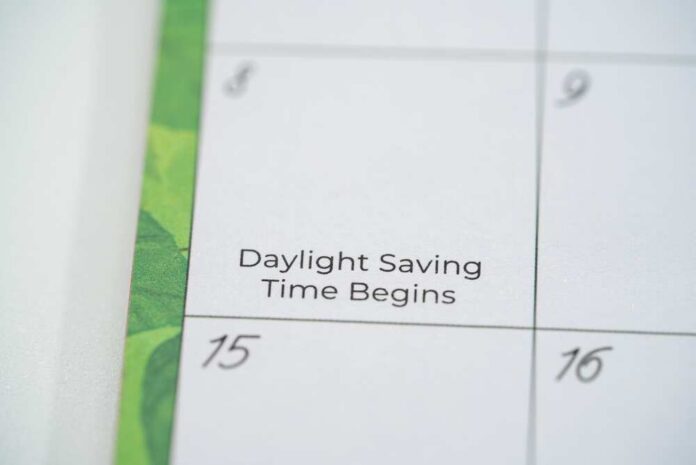
In one loud afternoon vote, the House moved to “lock the clock” — but the real fight over your mornings and your health is only just starting.
Story Snapshot
- House passed the Sunshine Protection Act 308–117, with bipartisan support and Trump backing.
- The bill would end clock changes and make daylight saving time America’s new permanent time.
- States like Arizona and Hawaii keep special options, but only if they act before the bill becomes law.
- Top sleep doctors warn that permanent daylight saving time could hurt health more than it helps convenience.
House Vote Pushes Permanent Daylight Saving Time Closer Than Ever
The United States House of Representatives did something many Americans have begged for: it voted to stop the twice‑a‑year clock change and make daylight saving time permanent nationwide.
The Sunshine Protection Act, H.R. 139, sailed through the chamber on a 308–117 vote, drawing Republicans and Democrats to the same side for once. That kind of margin is rare in today’s Congress and signals just how annoyed people are at having to lose sleep every March and November.
The bill’s core move is simple but huge. It makes the current daylight saving schedule — the time you live on from March through November — the new “standard” time all year. Clocks would spring forward once more and then stay there.
Supporters frame it as a fix that better aligns with modern life, with more evening daylight and fewer cranky mornings after the switch. The White House has backed the effort, as has President Donald Trump, adding even more political muscle behind the push.
What The Sunshine Protection Act Actually Changes
Under current law, the Uniform Time Act of 1966 establishes our seasonal time system, including a section that creates the temporary daylight saving period. H.R. 139 repeals that section outright.
It then advances standard time across all U.S. time zones by one hour, basically locking in what we now call daylight saving time as the new baseline. That would ripple through every schedule that depends on federal time rules, from airline timetables to broadcast hours and financial markets.
The House of Representatives approved legislation Tuesday that would make daylight saving time permanent.https://t.co/UVSFxzvl2g pic.twitter.com/HtRsKmYSZ5
— NEWSMAX (@NEWSMAX) July 15, 2026
The bill also addresses states that already operate off the daylight saving time grid. Places like Hawaii and most of Arizona, plus territories such as Puerto Rico and Guam, currently stay on standard time year‑round.
H.R. 139 gives these opt‑out states and areas a special choice. They can adopt the new national standard, or they can keep the same standard time they had before the law passed.
That “grandfather” protection only applies if their lawmakers keep the exemption in place up to the date of enactment, which means state legislatures now have a real deadline staring them down.
The Senate Roadblock And A Missing Start Date
Despite the big House win, nothing changes on anyone’s clock yet. The bill now heads to the Senate, where similar daylight saving efforts have fizzled before.
Senators have a long history of stalling time bills once health concerns, business interests, and cross‑border scheduling headaches start to pile up. Until the Senate passes its own version and President Trump signs it, the Sunshine Protection Act is just a strong signal, not settled law.
Another wrinkle: the bill does not spell out a clear future start date. Analysts reviewing the text note that the change would take effect upon enactment rather than on some distant, planned Sunday at 2 a.m. That sounds decisive, but for airlines, schools, and global markets, it is vague and potentially messy.
Without a set date on the calendar, long‑range planning is harder. That kind of loose drafting clashes with the preference for predictability and orderly transition, especially in areas that touch every citizen’s daily routine.
Health Experts Say The Real Problem Is Dark Mornings, Not Clock Switching
While many Americans cheer the idea of “no more clock changes,” medical and sleep experts are focused on a different question: which time should be permanent?
A major study from Stanford University modeled health outcomes county by county. It found that sticking with permanent standard time would prevent about 300,000 stroke cases and 2.6 million obesity cases nationwide, while permanent daylight saving time would prevent far fewer — roughly 220,000 strokes and 1.7 million obesity cases.
Should daylight saving time still exist?
The House passed a bill on Tuesday that would make DST permanent, but the Senate will also have to pass the bill before it can be signed into law.
In the interim, Baltimore Sun reporters debate the merits of the practice.
🎥: Caleb… pic.twitter.com/k1GFNb26CB
— The Baltimore Sun (@baltimoresun) July 15, 2026
The American Academy of Sleep Medicine has been blunt. Its formal position paper says the evidence “best supports the adoption of year‑round standard time.” Sleep specialists argue our internal clocks are set by morning light, not evening barbecues.
When sunrise is pushed later deep into winter, kids go to school in the dark, commuters drive before dawn, and the body’s natural rhythm gets knocked off balance. That misalignment shows up as more heart attacks, more car crashes, more workplace injuries, and more mood and weight problems.
Culture, Convenience, And Conservative Common Sense
Here is the clash in plain English. Businesses in golf, film, and other leisure industries love permanent daylight saving time because longer evening light means more customers and more money. Lawmakers hear from those groups and see a popular annoyance — clock changes — they can fix fast.
On the other side, leading doctors and sleep scientists warn that darker mornings and permanent social jet lag are not worth the trade. They do not deny that clock changes cause problems; they just say the right fix is permanent standard time instead.
From this view, the key question is whether Washington is choosing the healthy solution or the flashy one. Ending forced clock changes makes sense.
Most parents, workers, and small business owners would welcome that stability. But picking permanent daylight saving time over permanent standard time, in spite of clear medical warnings, looks like the government listening harder to lobbyists than to doctors.
The House has taken a big step; whether the Senate slows down and asks tougher questions will tell us who is really setting national time — industry, or science aligned with everyday family life.
Sources:
thehill.com, govinfo.gov, energycommerce.house.gov, billtrack50.com, buchanan.house.gov, policyrisk.com, en.wikipedia.org, med.stanford.edu, time.com, pmc.ncbi.nlm.nih.gov, health.harvard.edu