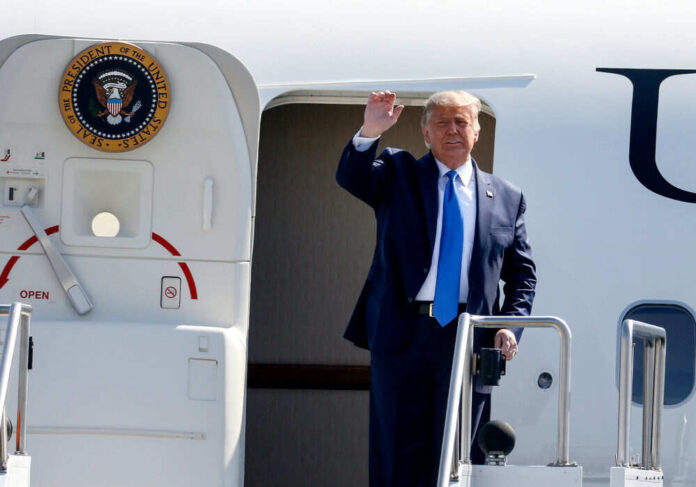
Spirit Airlines pilots ignored repeated air traffic control warnings while flying dangerously close to President Trump’s Air Force One, prompting controllers to finally bark, “Pay attention, get off the iPad,” during the harrowing near-miss over Long Island.
Story Highlights
- Spirit Airlines Flight 1300 flew within dangerous proximity of Air Force One during Trump’s UK state visit.
- Air traffic controllers issued multiple urgent warnings before pilots finally responded.
- Audio recordings captured the controller’s frustration with distracted commercial pilots.
- Incident exposes serious gaps in aviation safety protocols involving presidential aircraft.
Presidential Security Compromised by Pilot Negligence
What should have been a routine presidential departure from Joint Base Andrews nearly turned into a catastrophic aviation incident when Spirit Airlines pilots repeatedly failed to respond to air traffic control instructions.
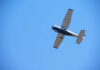
The commercial flight, operating as Flight 1300 from Fort Lauderdale to Boston, came alarmingly close to Air Force One carrying President Trump to his state visit with King Charles and Queen Camilla.
This level of inattention from commercial pilots during presidential flight operations represents an unacceptable breach of aviation safety protocols that protect our commander-in-chief.
The incident occurred approximately 30 minutes after Air Force One departed, with both aircraft converging over Long Island’s already complex airspace. New York Center controllers, responsible for managing some of the nation’s busiest air corridors, found themselves dealing with unresponsive commercial pilots while the presidential aircraft maintained its course.
The fact that it took multiple urgent commands before Spirit pilots acknowledged instructions raises serious questions about cockpit discipline and pilot training standards at budget carriers.
Air Traffic Control Audio Reveals Mounting Frustration
Audio recordings shared by aviation enthusiasts captured the escalating tension as controllers struggled to get Spirit pilots’ attention.
The controller’s commands grew progressively more urgent: “Pay attention, Spirit 1300, turn 20 degrees right” before finally delivering the pointed rebuke about getting off electronic devices.
While Bloomberg News noted they could not independently verify the recordings, multiple aviation outlets reported consistent details about the controller’s frustration with the delayed pilot response.
The final separation saw both aircraft crossing over Long Island Sound about one minute apart, with the Spirit plane flying 9,000 feet below Air Force One.
Though the aircraft maintained what aviation authorities consider safe separation distances, the initial convergence should never have occurred, given the enhanced security protocols surrounding presidential flights.
This near-miss highlights how pilot distraction and delayed responses can quickly escalate routine air traffic situations into potentially dangerous encounters.
Budget Airline Standards Under Scrutiny
This incident puts Spirit Airlines’ operational standards under intense scrutiny at a time when Americans are already questioning the reliability of budget carriers. The suggestion that pilots were distracted by electronic devices during a critical flight phase involving the presidential aircraft is deeply concerning.
Commercial pilots are supposed to maintain constant vigilance and immediate responsiveness to air traffic control, especially in busy airspace where government and commercial aircraft operate in proximity.
The timing couldn’t be worse for Spirit Airlines, which has faced mounting criticism over service quality and safety culture.
When pilots flying a budget airline show such apparent disregard for air traffic control instructions while the President of the United States is airborne nearby, it raises fundamental questions about hiring standards, training protocols, and cockpit discipline at low-cost carriers.
American taxpayers and travelers deserve better than pilots who need to be told to “pay attention” during critical flight operations.
Implications for Presidential Travel Security
This near-miss exposes potential vulnerabilities in the extensive coordination systems designed to protect presidential travel.
The Secret Service, FAA, and air traffic control invest enormous resources in establishing temporary flight restrictions and enhanced monitoring procedures when Air Force One operates.
Yet those safeguards proved insufficient when commercial pilots ignored or failed to acknowledge controller instructions in real-time promptly.
President Trump completed his journey to London safely, and his state visit proceeded as planned, but this incident should trigger immediate reviews of how commercial and government aircraft coordination works in practice.
The fact that our air traffic control system prevented an actual collision demonstrates the professionalism of our controllers, but it also reveals how quickly situations can deteriorate when commercial pilots don’t maintain proper attention and responsiveness during presidential flight operations.