The Supreme Court appears ready to deliver a stinging rebuke to President Trump’s executive order restricting birthright citizenship, raising concerns that even conservative justices may be abandoning constitutional originalism in favor of activist precedent that has fueled decades of illegal immigration incentives.
Story Snapshot
- Supreme Court justices, including conservatives Roberts and Gorsuch, expressed skepticism toward Trump’s executive order limiting birthright citizenship during historic April 1, 2026, oral arguments
- President Trump made an unprecedented personal appearance at arguments in Trump v. Barbara, marking the first time a sitting president attended Supreme Court proceedings
- Executive order reinterprets 14th Amendment’s “jurisdiction” clause to exclude children of illegal immigrants and temporary visitors, challenging 126 years of expansive precedent
- Administration argues birthright citizenship was intended only for freed slaves and legal residents, not as incentive for illegal immigration and birth tourism
- Ruling could affect millions of U.S.-born children of undocumented immigrants and determine whether Congress or courts control citizenship policy
Trump Attends Historic Supreme Court Arguments
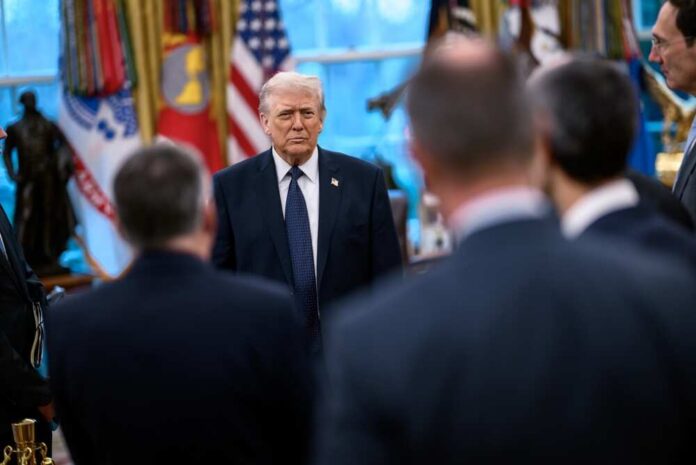
President Trump made history on April 1, 2026, by attending oral arguments at the Supreme Court as justices heard challenges to his Day 1 executive order restricting birthright citizenship. Trump’s presence marked an unprecedented moment—no sitting president had ever attended Supreme Court arguments in person.
The president departed mid-session during ACLU attorney Cecilia Wang’s presentation defending constitutional birthright citizenship for all U.S.-born children. The case, Trump v. Barbara, represents a class-action lawsuit challenging the administration’s attempt to reinterpret the 14th Amendment’s citizenship guarantee.
The executive order would require new verification systems beyond traditional birth certificates, fundamentally altering how American citizenship is documented and conferred.
Conservative Justices Signal Reluctance on Constitutional Reinterpretation
Chief Justice John Roberts and Justice Neil Gorsuch joined liberal justices in expressing skepticism toward Solicitor General John Sauer’s arguments that the 14th Amendment’s “jurisdiction” clause excludes children of illegal immigrants and temporary visitors.
Sauer contended the amendment targeted freed slaves specifically, not children of “non-domiciled aliens,” and that precedents like the 1898 U.S. v. Wong Kim Ark decision applied only to legal residents. However, multiple justices appeared unconvinced by this narrow reading, creating a “frosty reception” for the administration’s position.
This resistance from Trump-appointed and conservative justices raises troubling questions about whether the Court will defer to precedent that has incentivized illegal immigration rather than examining the amendment’s original intent to address post-Civil War citizenship for freed slaves.
Breaking News: Key Supreme Court justices appeared skeptical of President Trump’s efforts to limit birthright citizenship during oral arguments. Follow updates here. https://t.co/G7lfh29XmN
— The New York Times (@nytimes) April 1, 2026
Constitutional Text Versus Judicial Activism Debate
The 14th Amendment states: “All persons born or naturalized in the United States, and subject to the jurisdiction thereof, are citizens.” Ratified in 1868 to overturn Dred Scott v. Sandford and secure citizenship for freed slaves, the amendment’s “jurisdiction” language has become the crux of debate.
The administration argues this clause excludes those whose parents owe allegiance to foreign nations, citing the 1884 Elk v. Wilkins precedent that denied citizenship to Native Americans due to tribal allegiance. ACLU attorney Wang countered that “everyone born here is a citizen alike,” invoking Wong Kim Ark’s broad territorial interpretation.
Conservative commentators like Mike Davis argue the Court should restore “sanity” through originalism, recognizing the amendment never intended to reward illegal border crossing or birth tourism schemes that have flourished under expansive judicial readings.
Immigration Policy and Sovereignty at Stake
The Trump administration’s executive order directly addresses what many conservatives view as a critical sovereignty issue: whether the United States can control who becomes a citizen or whether automatic birthright citizenship creates an irresistible magnet for illegal immigration.
The order seeks to end “birth tourism,” where foreign nationals temporarily enter the country specifically to birth children who automatically receive citizenship, and to eliminate citizenship as an incentive for illegal border crossing. Millions of U.S.-born children of undocumented immigrants could be affected if the Court upholds the administration’s position.
The case also raises fundamental questions about separation of powers—whether Congress, not executive orders or judicial precedent, should determine citizenship criteria through legislation as the Constitution’s framers intended.
Court Decision Could Reshape Immigration Landscape
Based on oral argument tone, justices appear poised to reject Trump’s birthright citizenship limits, potentially maintaining the status quo that conservatives argue has undermined immigration enforcement for generations.
A ruling against the administration would reinforce Wong Kim Ark’s expansive interpretation and could prompt congressional action to clarify citizenship laws through statute rather than executive or judicial fiat.
Alternatively, if the Court surprises observers and upholds the order, it would represent a seismic shift in constitutional interpretation, empowering the executive branch to redefine citizenship and potentially spurring legislation to codify or reverse the policy.
The decision will determine whether the 14th Amendment’s text is read through an originalist lens focused on freed slaves or through precedent emphasizing territorial birth regardless of parental legal status, immigration circumstances, or national allegiance.
Sources:
Supreme Court appears skeptical of Trump’s case to end birthright citizenship – ABC News
Mike Davis: Sanity must be restored on birthright citizenship – Fox News Opinion
The key arguments in the birthright citizenship case – SCOTUSblog
What to know about Supreme Court’s blockbuster birthright citizenship case – Fox News
Live coverage: Birthright citizenship SCOTUS oral arguments – ACLU
Birthright citizenship: Hard questions and the best answers for Trump’s challengers – SCOTUSblog
Supreme Court Arguments in Barbara v. Trump Birthright Citizenship – Asian Law Caucus
Supreme Court birthright citizenship oral arguments – The 19th News