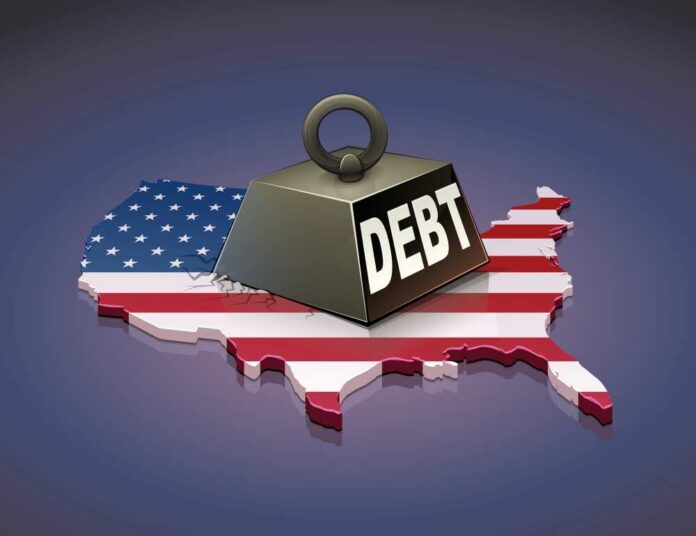
Household debt in America has quietly climbed to record highs, and the real danger is how fragile that makes both families and the broader economy when the next shock hits.
Story Snapshot
- U.S. household debt has hit an all-time high near $19 trillion, while savings have thinned.
- Société Générale warns this debt-driven “wealth effect” boom could flip fast when markets or jobs stumble.
- Federal Reserve officials still call household vulnerabilities “moderate,” which calms nerves but may dull urgency.
- History and research show high debt can boost growth now but slow the economy and deepen future recessions.
How Americans Got To A Record Debt Pile Without Noticing
Total household liabilities in the United States have climbed to around $19 trillion, the highest level on record.[1] Most of this debt sits in mortgages, but auto loans, credit cards, and student loans now add growing weight to family budgets.[14]
Debt ballooned after the pandemic as consumers went back to normal life, prices jumped, and easy credit filled the gap between wages and the new cost of living.[14] Many households did not “go wild”; they simply tried to keep their lifestyle from slipping.
'RUNNING OFF THE CLIFF': AN EXPLOSION OF HOUSEHOLD DEBT HAS PUT THE US ECONOMY IN A TOUGH SPOT
In a recent note to clients, the European Bank flagged a concerning trend that's taken hold in the US in recent years: the rise in household debt and the concurrent decline in… pic.twitter.com/o3P26zmtpM
— FXHedge (@Fxhedgers) June 21, 2026
Research from the Federal Reserve shows that, despite the big dollar totals, household debt as a share of the overall economy is still near 20‑year lows.[5][19] That sounds calming, and it is part of why central bankers keep calling household risks “moderate.”[5]
But families do not pay bills with gross domestic product. They pay them with paychecks that have not always kept up with housing, car, and food costs. That gap is where trouble breeds.
Why Société Générale Is Ringing The Alarm Bell
Société Générale strategist Albert Edwards argues that U.S. consumers are “running off the cliff,” borrowing more while saving less because rising markets make them feel richer on paper.[1][4] That is the classic wealth effect: home prices and stocks jump, people feel secure, and they stop worrying about the rainy-day fund.
When spending leans on debt instead of savings, the whole system becomes much more sensitive to any drop in asset prices or income. A stock slump or housing slide then hits both your balance sheet and your job at the same time.
Edwards also points to a darker twist: it now takes more and more new credit to squeeze out the same amount of economic growth.[1] Analysts at Bespoke Investment report that the “credit intensity” of gross domestic product has climbed to its highest level in at least 70 years.[1]
Plain English translation: every extra dollar of growth now needs a larger dose of borrowed money to get there. That pattern should bother anyone who cares about long‑term prosperity, because it looks less like healthy investment and more like an economy hooked on leverage.
The Counterargument: Why Officials Still Say Risk Is “Moderate”
Top officials at the Federal Reserve look at the same pile of debt and see something less scary, at least for now. Their April 2025 Financial Stability Report notes that total private debt, adjusted for inflation and compared with the economy, has drifted down, not up.[5][19]
Most household mortgages are fixed‑rate loans locked in when interest rates were lower, so higher recent rates have not yet crushed most homeowners’ budgets.[19] Required debt payments as a share of disposable income remain slightly below pre‑pandemic levels, which suggests many families still have some breathing room.[19]
History also shows that high household debt alone rarely causes a recession. Crises usually show up when heavy debt collides with a spike in unemployment or a rapid jump in interest costs.
Research across dozens of countries finds that rising household debt often boosts growth for a year or two, because families can spend more in the short run.[6][12] That is why many economists resist the idea that today’s debt figures alone guarantee an imminent crash. They see a slow‑burn problem, not a ticking bomb set for next month.
The Hidden Cost: When Today’s Debt Becomes Tomorrow’s Drag
The deeper research picture is less comforting for anyone who thinks debt does not matter as long as people keep paying. Economists at the Bank for International Settlements studied over 50 economies and found that when household debt rises too far relative to the size of the economy, long‑run growth slows.[6][12]
Each percentage point rise in the household debt‑to‑gross‑domestic‑product ratio is linked with a 0.1 percentage point drop in future growth.[6][12] That may sound small, but spread over years it adds up to weaker incomes and fewer chances for the next generation.
Brookings Institution researchers add another warning: high long‑term household debt drags on growth through the weight of future payments.[13] Their work shows that while new borrowing can give the economy a short burst, the later rise in debt service tends to cut spending and output more than that earlier boost added.[13]
Once households commit to these payments, they feel the pressure for years, especially in a world of higher interest rates. That is the slow squeeze Americans may be walking into now.
Who Gets Hurt First When The Music Stops
Debt stress never hits everyone the same way. Studies of U.S. household finances show that the bottom fifth of families carry the highest debt‑to‑income ratios and rely more on borrowing just to keep up with basic consumption.[11][3]
These households also have the thinnest savings and the least stable jobs. When interest rates rise or hours get cut, they do not trim “luxury” spending; they choose between gas, groceries, and the car payment. That is where delinquency and default begin to spike first.[18]
New York Federal Reserve data already show rising delinquencies on auto loans and credit cards, with some measures returning toward levels last seen around the 2008 crisis.[18] Advocacy groups tracking the same data describe a “perfect storm” where more borrowers fall behind on more than one type of loan at once.[18]
From a common‑sense view, this points to a deeper policy failure: a system that pushes people to borrow to survive while Washington keeps chasing short‑term growth numbers and ignores the basic link between stable work, sound money, and family resilience.
What A Prudent Path Forward Looks Like
None of this means a household‑debt crash is guaranteed next year. It does mean the margin of error is shrinking. The responsible course is not to panic, but to rebuild buffers.
For policymakers, that means resisting the urge to juice demand with ever more credit and instead focusing on wage growth from real productivity, not money printing. For lenders, it means tighter underwriting and less faith that rising asset prices will save every risky loan when the cycle turns.
For families, the lesson is even simpler and more urgent than the slogans in popular money books. Research comparing academic advice to common financial gurus finds that almost all the bestselling authors push emergency savings as a first step, even when that feels hard.[8]
In an economy propped up by record household debt and fading savings, that old‑fashioned habit may be the thin line between “running off the cliff” and having just enough runway to pull up when the next shock hits.
Sources:
[1] Web – ‘Running off the cliff’: An explosion of household debt has put the US …
[3] Web – Mortgage Banking Update – June 4, 2026 | Alerts and Articles | …
[4] Web – [PDF] BOX 3.1 The costs of hidden debt – The World Bank
[5] Web – ‘Running off the cliff’: An explosion of household debt has put the US …
[6] Web – Monthly House Views – On a roll ! – June 2026
[8] Web – [PDF] first amendment to universal registration document – Société …
[11] Web – Private Credit Outlook 2026 – With Intelligence
[12] Web – Keeping Up with Household Debt in the US
[13] Web – [PDF] The real effects of household debt in the short and long run
[14] Web – Navigating the long shadow of high household debt | Brookings
[18] Web – Household Debt and Credit Report
[19] Web – American Families Hit Record Levels of Financial Distress as …