

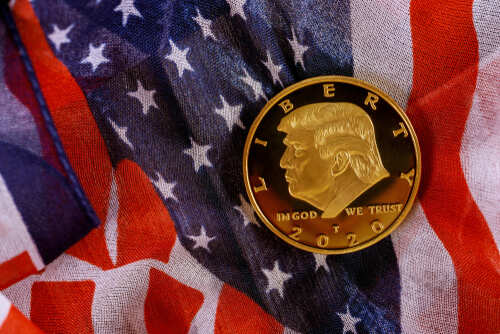
Treasury just found a legal lane to put a sitting president’s face on a U.S.-minted gold coin—and Washington’s usual “norms” debate is already spilling into the fight over crypto rules and ethics guardrails.
Quick Take
- The Commission of Fine Arts unanimously approved a 24-karat gold Trump commemorative coin design on March 20, 2026.
- Treasury Secretary Scott Bessent relied on authority in 31 U.S.C. § 5112, a move reported as unusual because U.S. currency traditionally avoids living persons.
- Trump personally reviewed and selected the design, while the Citizens Coinage Advisory Committee declined to review the proposals.
- The debate over “ethics guardrails” is unfolding as Treasury implements stablecoin rules and Congress negotiates the CLARITY Act.
How the Gold Coin Was Approved—and Why the Process Matters
The Commission of Fine Arts approved the final design for a Trump-themed 24-karat gold commemorative coin, with no objections reported.
The approved artwork depicts President Trump in a suit and tie, with a stern expression, leaning forward, his hands resting on a desk. The obverse includes “LIBERTY” and the dual dates 1776–2026, and the reverse features a bald eagle with “UNITED STATES OF AMERICA” and “E PLURIBUS UNUM.”
Gold Trump coin moves forward after Treasury invokes rare authority https://t.co/sR2dU2pQwE
— FOX Business (@FoxBusiness) March 20, 2026
Treasury’s rationale hinges on the difference between circulating money and commemorative or bullion-style pieces. Reporting describes a longstanding prohibition and tradition against placing living individuals on U.S. currency, intended to prevent government instruments from becoming personalized.
Treasury officials have stressed that this coin is not ordinary circulating currency, and different authorities administer that commemorative and bullion programs than the bills and coins Americans use at the register.
The “Rare Authority” Treasury Invoked Under Federal Law
Treasury Secretary Scott Bessent invoked authority under 31 U.S.C. § 5112 to authorize the coin, with coverage characterizing the tool as rarely used in this way. That statute gives the Treasury discretion over certain bullion and proof coin specifications, designs, and inscriptions.
Separately, the Circulating Collectible Coin Redesign Act of 2020 also created temporary room for 2026-themed designs, aligning with the “America 250” semiquincentennial focus now shaping federal commemorative planning.
Design Oversight: A Unanimous Vote, a Reconstituted Panel, and an Advisory Boycott
The oversight trail is part of why the story isn’t just about a collectible. Reporting says the Commission of Fine Arts was reconstituted earlier in 2026 with Trump supporters and that Trump appointed its members.
At the same time, the Citizens Coinage Advisory Committee—described as an independent advisory body—declined to review the designs and removed them from its agenda. Treasury officials argue that CCAC had opportunities to weigh in and chose not to.
Why the Coin Story Collides With Stablecoin Regulation and the CLARITY Act
The coin also lands in the middle of a separate policy fight: Treasury’s role in digital-asset regulation. In late February 2026, the Office of the Comptroller of the Currency, a Treasury bureau, published a lengthy proposed rule implementing the GENIUS Act’s stablecoin framework.
As those rules take shape, negotiations over the CLARITY Act have reportedly stalled on ethics provisions, with Senate Democrats pressing for explicit limits on senior officials profiting from crypto assets.
What We Know, What’s Still Undecided, and the Core Constitutional Tension
Several key details remain unresolved, including final specifications such as denomination and production size, with commissioners reportedly pushing for the largest available format—up to three inches in diameter.
Reporting also indicates the administration is planning additional Trump-face coins, including a circulating $1 coin and a collectible one-ounce 24-karat gold coin carrying a $250 face value. Those outstanding decisions mean the public still lacks a complete picture of scale, availability, and program boundaries.
The political argument is sharpening around guardrails rather than metallurgy. Senate Democrats have argued that the overlap of Treasury authority—coin programs and stablecoin regulation—should be constrained by clearer ethics rules, while Republicans and the White House have resisted those demands and deny a conflict.
The limited-government concern is straightforward: when discretionary authority expands without bright-line rules, future administrations can reuse the same playbook, regardless of party.
Sources:
The Treasury Secretary Who Sets Stablecoin Rules Just Put Trump’s Face on a Gold Coin
Gold Trump coin moves forward after Treasury invokes rare authority
Federal commission approves design for Trump commemorative gold coin
Trump Gold Coin, 250th Anniversary Commemorative, and the Living-Person Tradition