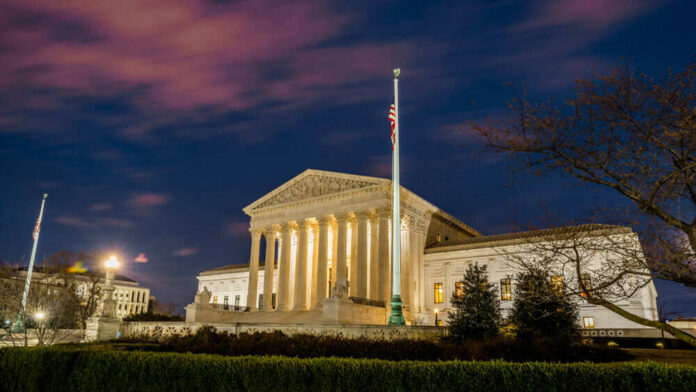
The Supreme Court has drawn a clear line in the sand: states may protect girls’ and women’s sports based on biological sex, not gender identity.
Story Snapshot
- Supreme Court rules 6-3 that Title IX allows sex-separated sports based on biological sex, upholding bans on transgender girls in female teams.
- Justice Brett Kavanaugh writes that “sex” in the 1972 Title IX law means biological sex, with safety and competitive fairness as key concerns.
- The decision shields similar laws in roughly half the country, where about 27 states have moved to protect women’s sports.
- Liberal justices and activist groups call the ruling a “devastating setback,” signaling more political and legal battles ahead.
High Court Confirms States Can Protect Women’s Sports
The Supreme Court’s ruling in West Virginia v. B.P.J. and the related Idaho case settles a major question that has divided courts, school boards, and parents for years. In a 6-3 decision, the justices held that state laws keeping transgender girls and women off girls’ and women’s school sports teams do not violate the Constitution or Title IX.
Justice Brett Kavanaugh’s majority opinion says Title IX has always allowed schools to separate teams by sex to protect fair and safe opportunities for female athletes.
Kavanaugh’s opinion answers the key legal fight: what did Congress mean by “sex” when it passed Title IX in 1972? The Court states that “sex” in that law refers to biological sex, not gender identity, and that this original meaning controls unless Congress rewrites the statute.
By grounding the ruling in the text and history of Title IX, the Court rejected arguments from activists and some lower courts that civil rights law must treat gender identity as the same thing as sex for sports participation.
Fairness and Safety Put Back at the Center
The majority opinion puts competitive fairness and safety for girls at the center of the legal standard. Kavanaugh wrote that safety concerns and fair competition are the “touchstones” that justify sex-based separation in athletics.
Supporters of the bans argued that male puberty changes speed, strength, and power, and that women lose chances at medals, titles, and scholarships when forced to compete against athletes who went through male development. Over 100 athletes and coaches told the Court that women should not have to give up a level playing field.
🚨 The Supreme Court upheld West Virginia and Idaho laws limiting girls' and women's school sports teams to biological females, holding that Title IX permits sex-separated teams based on biological sex and that the laws do not violate the Equal Protection Clause. pic.twitter.com/XyjSmux2rh
— SCOTUS Wire (@scotus_wire) June 30, 2026
At the same time, the Court recognized that science and policy details are still being debated, especially for transgender athletes who took puberty blockers early. The opinion describes this as a “debated policy question” and notes there was no definitive peer‑reviewed study in the record that resolved how medical interventions affect long‑term performance.
The justices chose not to turn the Supreme Court into a science panel, instead leaving room for state lawmakers to weigh emerging research while keeping Title IX’s core promise of equal opportunity for biological females.
Trump-Era Policy, State Laws, and Media Backlash
This ruling lands after years of policy moves under President Trump’s administration that pushed federal agencies to read Title IX as protecting sex-separated teams. In 2025, Trump signed an executive order directing enforcement of Title IX based on sex at birth and signaling that schools allowing transgender girls on girls’ teams could lose federal funds.
During that same period, Republican-led states steadily passed laws saying “sex shall be recognized based solely on reproductive biology and genetics at birth” for school sports. By early 2026, 27 states had some form of restriction on transgender participation in girls’ sports.
SCOTUS Upholds Transgender Sports Bans
The Supreme Court upheld state bans on transgender athletes in girls' and women's sports, siding with West Virginia and Idaho in two closely watched cases.
Justice Brett Kavanaugh, writing for the majority, said that states may set… pic.twitter.com/RAUb0q4mhu
— ronald ham (@ronaldham15) July 1, 2026
Major media outlets and activist groups quickly framed the decision as a “major setback” for lesbian, gay, bisexual, transgender, and queer rights and a “devastating” blow to transgender students. The American Civil Liberties Union, which represented the athletes challenging the Idaho and West Virginia laws, condemned the ruling and warned it would harm transgender youth.
Three liberal justices dissented in part, arguing that lower courts should look more closely at individual constitutional challenges and questioning whether blanket bans are necessary in every case. Their views may fuel new lawsuits, but they do not change the binding rule the majority set.
What This Means for Families, States, and the Next Fights
For parents and daughters in the stands, the immediate impact is simple: states now have clear Supreme Court backing to keep female sports for biological females. Laws in Idaho, West Virginia, and at least two dozen other states are shielded from the claim that they automatically violate Title IX or equal protection.
Schools in those states can continue to run separate boys’ and girls’ teams, and they can bar transgender girls from taking spots on female teams, so long as they follow other parts of Title IX and provide equal overall athletic opportunities.
At the same time, the Court did not write a one-size-fits-all national rule for every detail. States like California, which currently allow transgender girls on girls’ teams under certain conditions, still have room to keep or adjust their policies, though they must now do so within the Supreme Court’s definition of “sex” as biological.
Ongoing lawsuits in more than 20 states will test how far legislatures can go in drawing lines, especially in edge cases where medical treatment may reduce physical differences. Expect more battles over data, safety records, and long-term performance, as both sides try to shape public opinion and future law.
Sources:
apnews.com, nytimes.com, facebook.com, mapresearch.org, wjlgs.law.wisc.edu, bestcolleges.com, youtube.com