
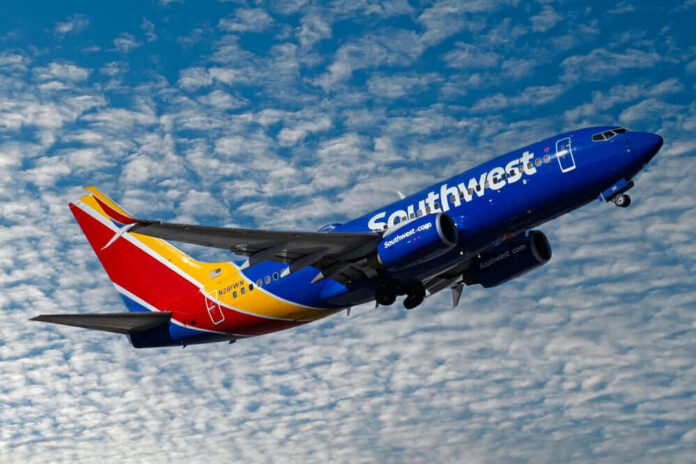
Southwest Airlines quietly reversed a policy that had passengers paying double for a single flight — and the full story of how it happened reveals just how messy the collision between airline logistics and public outrage can get.
Story Snapshot
- Southwest rolled back its January 2025 rule requiring larger passengers to purchase a second seat upfront before flying.
- Gate agents can now arrange a complimentary extra seat when adjacent seats are available, restoring a prior practice.
- The National Association to Advance Fat Acceptance credited public pressure from travelers, influencers, and activists for forcing the reversal.
- Southwest’s revised policy still conditions the free extra seat on seat availability, leaving enforcement partially in the hands of individual gate agents.
What Southwest Actually Changed and Why It Matters
Southwest’s January 2025 policy required passengers who needed a second seat to book and pay for it in advance, with a refund available only after travel and only under specific conditions.
That was a significant tightening from prior practice, where gate agents had discretion to arrange a complimentary seat on the spot when space allowed.
The reversal restores that gate-level flexibility, but it does not eliminate the underlying rule that passengers who encroach on a neighboring seat must use additional seating.[1]
Southwest framed the update as creating a “more consistent and seamless experience,” which is the kind of corporate language that tells you almost nothing about what actually went wrong.[4]
What it obscures is this: the January rule forced passengers into a bureaucratic loop — pay upfront, fly, submit a refund request within 90 days, hope the flight departed with available seats — that felt punitive regardless of intent.[3]
When a policy requires you to prove after the fact that you deserved accommodation you needed before you boarded, something in the design is broken.
The Safety Argument Is Real, But It Does Not Resolve the Fairness Question
Southwest’s written policy ties the second-seat requirement to two distinct rationales: seat encroachment affecting neighboring passengers, and safety.[2]
Both are legitimate operational concerns. Airlines are not obligated to pretend that cabin geometry is infinitely flexible, and the armrest boundary as an objective standard is at least more defensible than pure gate-agent guesswork.
The problem is that Southwest’s own language says the airline “reserves the right to determine” when safety requires a second seat, which means the standard is discretionary, not mechanical.[1] Discretionary enforcement applied to a sensitive physical characteristic is a reliable engine for inconsistency and perceived humiliation.
The National Association to Advance Fat Acceptance, known as NAAFA, praised the reversal and credited “fat travelers, influencers and activists” for holding Southwest accountable for what the organization called “recent cruel behavior.”[1] That framing is advocacy, and it should be weighed as such.
But the underlying grievance — that a passenger could arrive at a gate with no warning, be told there was no alternative, and face a choice between paying twice or not flying — is documented and credible.[5] A policy that routinely produces that outcome has a design flaw, whatever its stated rationale.
The Reversal Does Not Mean the Original Policy Was Indefensible
Rollbacks driven by public backlash are not the same as admissions of wrongdoing, and it is worth being precise about that distinction. Many airlines require passengers to purchase extra seats when their body size affects neighboring travelers. Southwest is not an outlier in maintaining that rule.[4]
The January policy’s flaw was not its existence but its mechanics — specifically, the upfront purchase requirement that transferred financial risk and logistical burden entirely onto the passenger before any accommodation was confirmed. That is where the policy lost the reasonable middle ground.
Southwest Airlines has rolled back part of its divisive policy requiring overweight passengers to buy two tickets on flights when they require a second seat because of their size. https://t.co/Qbq9vl13GB
— WJZ | CBS Baltimore (@wjz) May 29, 2026
The current revised policy still conditions the complimentary extra seat on adjacent seat availability, which means a full flight still creates a problem without a clean solution.[2] Southwest has not resolved the hardest version of this scenario. What it has done is remove the most visibly punitive element — the mandatory advance purchase — and return discretion to gate agents.
Whether that discretion is exercised consistently and respectfully depends entirely on training and culture, neither of which is visible in a help-center update. The passengers who will test that question are already booking flights.
Sources:
[1] Web – Southwest rolls back its overweight passenger policy. Here
[2] Web – Customers of Size Boarding & Airport Experience | Southwest …
[3] Web – Southwest Customer of size policy – Help Center | Southwest Airlines
[4] Web – Southwest updates extra-seat policy for plus-size passengers
[5] Web – Southwest FAQ — naafa