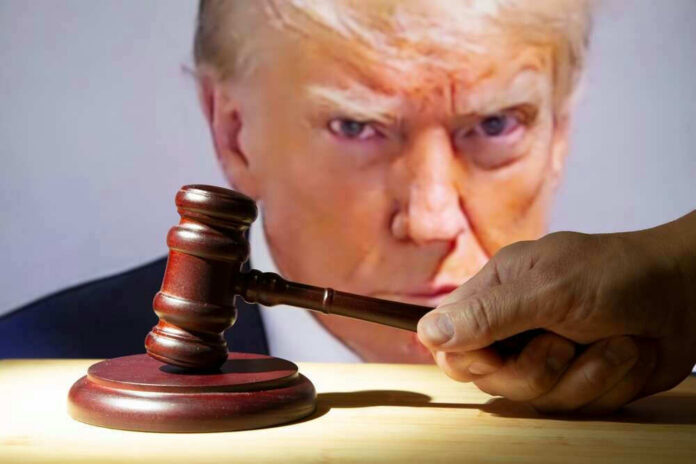
A nearly 30-year-old department store encounter just ended with a president ordered to hand over $5.8 million, and the way it happened says as much about modern America as it does about President Donald Trump and E. Jean Carroll.
Story Snapshot
- A federal jury found Trump sexually abused and defamed writer E. Jean Carroll, awarding her $5 million in 2023.
- Appeals failed all the way up: the Second Circuit upheld the verdict, and the Supreme Court refused to even hear Trump’s challenge.
- A judge has now ordered $5.8 million, including interest, released to Carroll from funds held for the judgment.
- The case turned on credibility, not forensic proof, and on harsh defamation standards that usually protect powerful figures.
How a 1996 Dressing Room Became a 2026 Payout
In the mid-1990s, columnist E. Jean Carroll says she ran into Trump at Bergdorf Goodman, a luxury store in Manhattan. She testified that playful banter led them to a dressing room, where Trump allegedly slammed the door, pinned her, and forced sexual contact as she tried to get away.
No physical evidence, no security video, and no medical records ever backed this story. Jurors had only people’s words, their memories, and their judgment about who to believe.
Carroll first went public decades later, in 2019, and Trump answered in the style he uses for most critics: attack hard, deny everything, and call it a hoax. Carroll then did something most public accusers never do successfully against a president.
She sued him for both sexual battery and defamation in federal court in New York. The case forced twelve jurors to weigh old claims, faded memories, and a famous man’s denials against a woman’s detailed story of shame and trauma.
What The Jury Actually Found Trump Did
The 2023 jury drew a sharp line between “rape” and “sexual abuse” under New York law. They rejected Carroll’s claim that Trump raped her as that statute defines rape, which focuses on penile penetration.
But they did find that Trump deliberately and forcibly penetrated her with his fingers, a form of sexual abuse that the judge later described bluntly as “digitally raping Ms. Carroll.” For that conduct and the harm it caused her, jurors awarded $2 million in sexual battery damages plus punitive damages.
Writer E. Jean Carroll can collect $5.8 million awarded to her after a jury found that President Donald Trump sexually abused and defamed her, a federal judge ruled Wednesday. MORE: https://t.co/ixCAMJ46kg pic.twitter.com/3hgyli7kQ8
— NEWSMAX (@NEWSMAX) July 8, 2026
The jury also ruled that Trump defamed Carroll when he publicly called her claim a lie and a con job in 2022. Under modern defamation law, that is no small hurdle. Public figures usually have strong protection for harsh speech and must be shown to have acted with “actual malice,” meaning they knew what they said was false or recklessly ignored the truth.
Jurors decided Trump crossed that line and gave Carroll about $2.7 million in defamation damages and additional punitive damages, bringing the total award to roughly $5 million.
Appeals, Propensity Evidence, and Concerns
Trump’s lawyers did not accept that verdict as the last word. They called the trial “indefensible” and argued the judge badly misused the federal rules of evidence.
They objected to the jury seeing the Access Hollywood tape, where Trump bragged about grabbing women, and hearing two other women testify about past alleged sexual assaults. They said this “propensity evidence” invited jurors to convict him for being the kind of man who might do such things, not for proven facts of this incident.
The United States Court of Appeals for the Second Circuit looked at those complaints and sided with the trial judge. It said the testimony and tape fit rules that allow other sexual assault evidence in some cases and that any possible errors did not change the outcome.
In plain terms, the appeals court believed the jury’s verdict rested on solid ground. From a rule-of-law view, that matters: the process was tested by higher courts, and they found no legal miscarriage, even if some Americans still dislike how broad modern “pattern” evidence can be.
Supreme Court’s Quiet but Final Word
After losing in the Second Circuit, Trump made one last move: he asked the Supreme Court of the United States to take the case and throw out the verdict. The Court declined to hear it, as it does with most petitions, offering no detailed explanation.
That refusal did not bless every part of the lower court’s reasoning, but it did lock in the result. The $5 million judgment became final, with no more federal appeals left.
Once the Supreme Court closed that door, the money became more than numbers on paper. A federal judge ordered that $5.8 million, including interest, held in escrow for the case be released to Carroll. Escrow is a kind of holding tank for money during legal fights; once appeals are over, those funds go where the judgment says.
Carroll’s lawyers called the ruling a clear sign that Trump’s efforts to dodge accountability had failed, while Trump’s allies argued the whole saga showed how politicized New York courts have become.
What This Case Really Signals About Speech, Power, and Memory
This case lands at the crossroads of several trends. First, more women now bring civil claims years after alleged abuse, knowing they may never have forensic proof and must rely on credibility alone.
Juries are asked to decide intimate, decades-old events they can never fully verify. Second, defamation law still gives public figures wide breathing room, yet this time a famous man’s “hoax” talk about his accuser crossed the line and cost him millions.
From a common-sense standpoint, two things can be true at once. It is troubling when courts lean heavily on pattern evidence and feelings about a defendant’s past words, especially in a political hot zone.
It is also true that the formal guardrails held: a jury heard both sides, a trial judge reviewed the verdict, an appeals court scrutinized the rulings, and the Supreme Court let the outcome stand. The system answered a woman’s claim against a powerful man not with tweets, but with a binding check.
Sources:
apnews.com, en.wikipedia.org, law.justia.com, caselaw.findlaw.com, instagram.com, facebook.com, latimes.com, nbcnews.com, pbs.org